BIER Table Lookup
Second part of the 3-article series on BIER, detailing how is performed the lookup in the different BIER Tables.
The series is composed of the following posts:
- Introduction to BIER and BIER Underlay
- BIER Table Lookup (present article)
- BIER Overlay
In this TechPost, we talk in deeper detail about the different tables such as the BIRT (Bit Index Routing Table) and the BIFT (Bit Index Forwarding Table), the FBM (Forwarind BitMap) representation, but also the BIER Layer and the BIFT lookup.
Bit Index Routing Table
The BIRT table is created per sub-domain of the BIER domain and it maps the BFR-Id of a BFER to the BFR-prefix of that BFER, and to the BFR-NBR on the path to that BFER.
Naming Convention
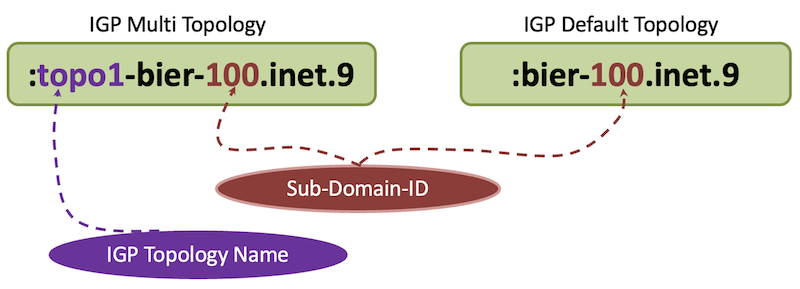
BIRT in JUNOS-EVO
The BIRT table contains the BFR-Prefixes of the BFIR/BFER routers in the BIER domain. As all BFIR/BFER falls into the same sets, the same BIER label is pushed to the packet.
Let's look into one of the routes in the BIRT, the multicast packet towards BFER R4, will be pushed with a BIER label of 16
The extensive output of the route in the BIRT table is as follows:
Bit Index Forwarding Table
Naming Convention
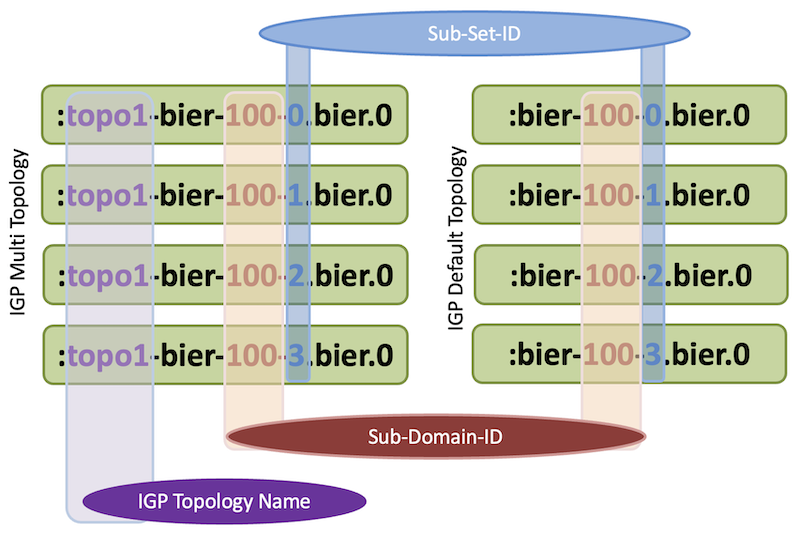
BIFT in JUNOS-EVO
When entire BFR-IDs fall into the first set, there will be only one BIFT table created as follows:
Whenever the BFR-ID is present in other sets, corresponding BIFT tables are created. In the following output, R1 is configured with BFR-ID of 1, R4 with 400, R5 with 600, R6 with 1000, and R7 with 7. R1 and R7 fall into the first set, R4 in the second, R5 in the third and R6 in the fourth. The format is BFR-ID/Mask. As per RFC, BFR-ID is a 2-byte or 16-bit field, so the mask is shown as 16 here.
The Router R1 and R7 having BFR-ID 1 and 7 fall into the first set:
Router R4 is configured with a BFR-ID of 300, which falls into the second set and its identifier within the second set is 44 (ie 300-256)
Router R5 is configured with a BFR-ID of 600, which falls into the third set and its identifier within the third set is 88 (ie 600-256*2)
Router R6 is configured with a BFR-ID of 1000, which falls into the fourth set and its identifier within the fourth set is 232 (ie. 1000-256*3)
Let's look into the BFR-ID in the BIFT table
The extensive output in the BIFT table contains the FBM information.
BIFT-FBM Formation
FBM View from BFR
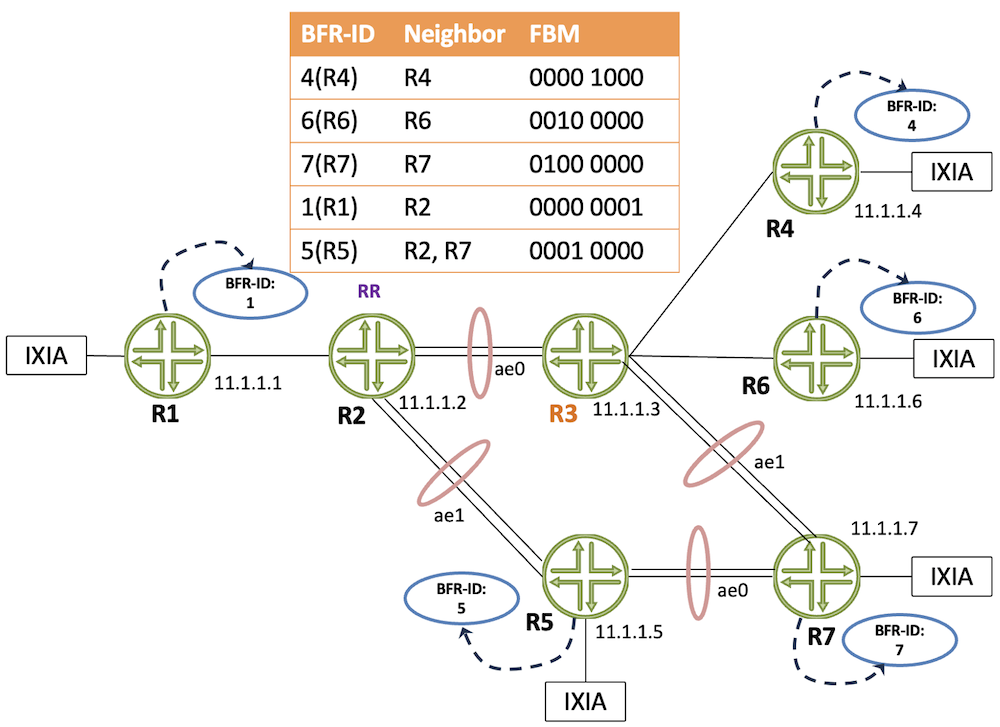
The BIFT-FBM table from the BFR router R3 is shown below in Figure 3. The BFIR/BFER R4, R6, and R7 are directly reachable, hence only one bit got set in the FBM. Router R1 and R5 are reachable via R2, hence logical OR operation of those two routers form the FBM, ie having two bits set in the FBM. Router R5 is reachable via two ECMP paths(via R2, via R5).
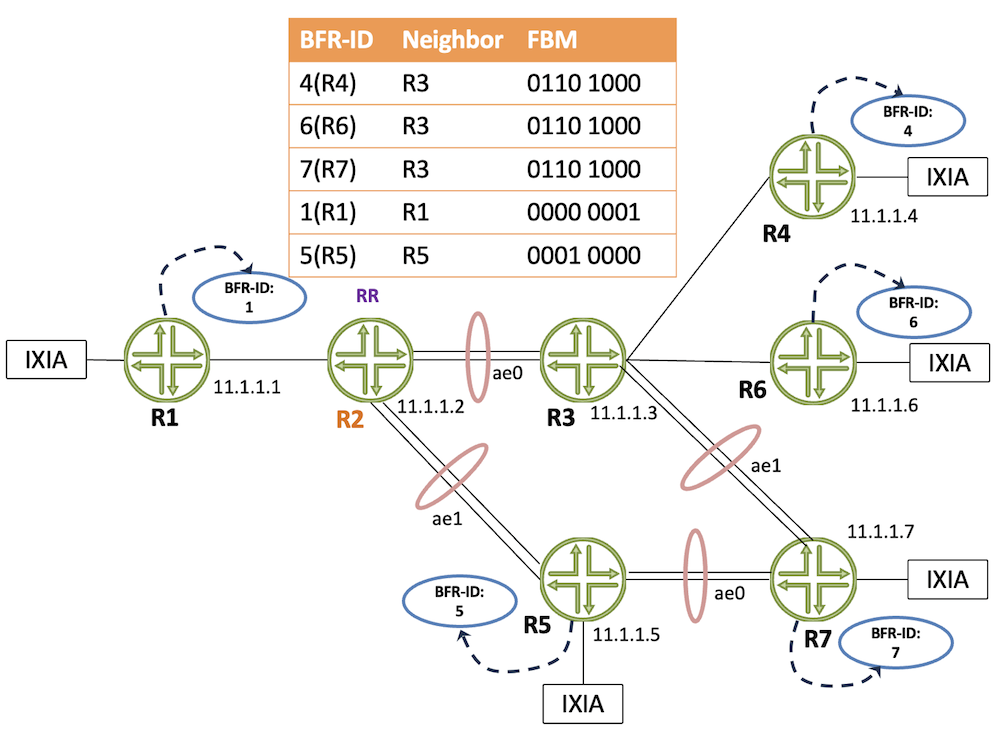
The BIFT-FBM Table from the BFR router R2 is shown below. The BFIR/BFER R4, R6, and R7 are reachable via R3, hence three bits are set in the FBM, whereas R1, and R5 are directly reachable hence only one bit got set.
FBM View from BFIR/BFER
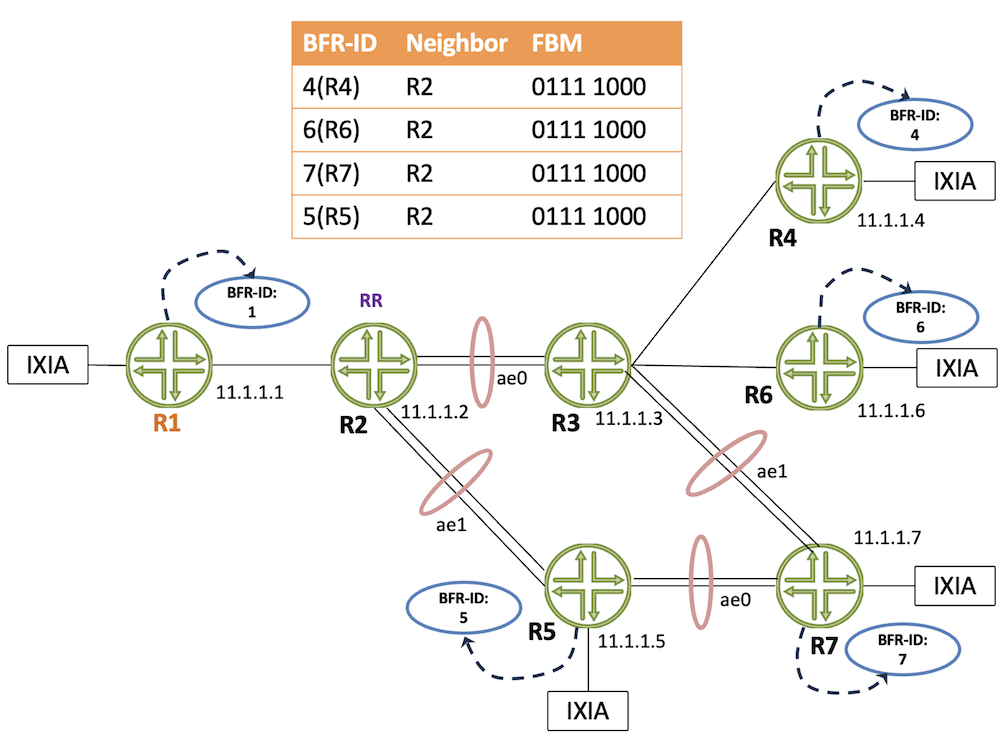
Let's get the BIFT-FBM table from BFIR/BFER router R1. As all other BFIR/BFER are reachable via R2, all bits corresponding to R4, R5, R6, and R7 will be set.
Decoding FBM BitString in JUNOS-EVO
In JUNOS FBM BitString is present in the BIER neighbour table info.
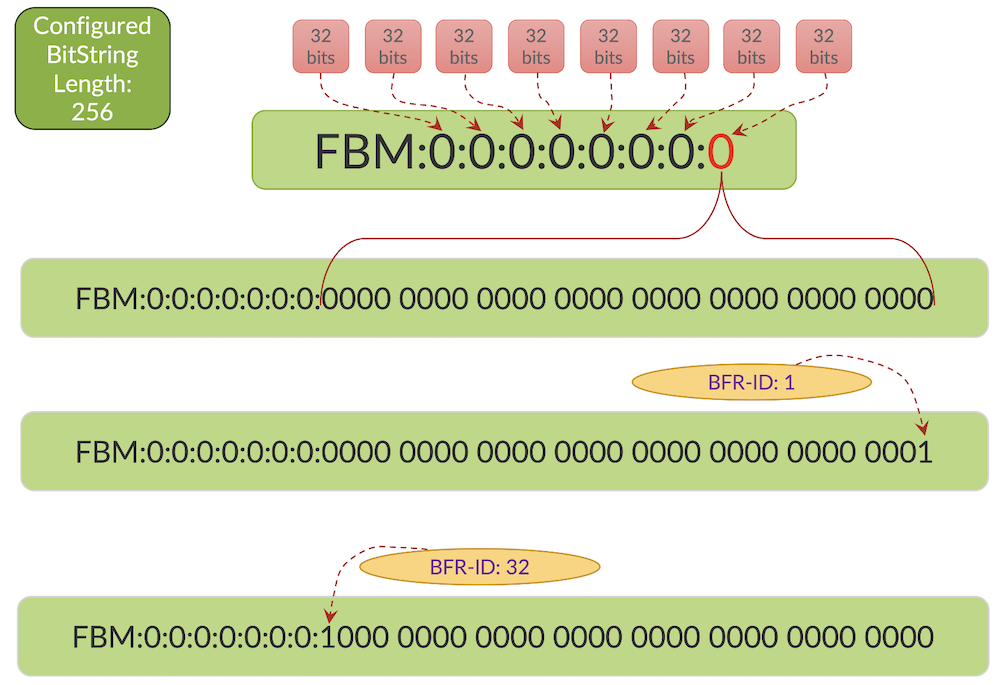
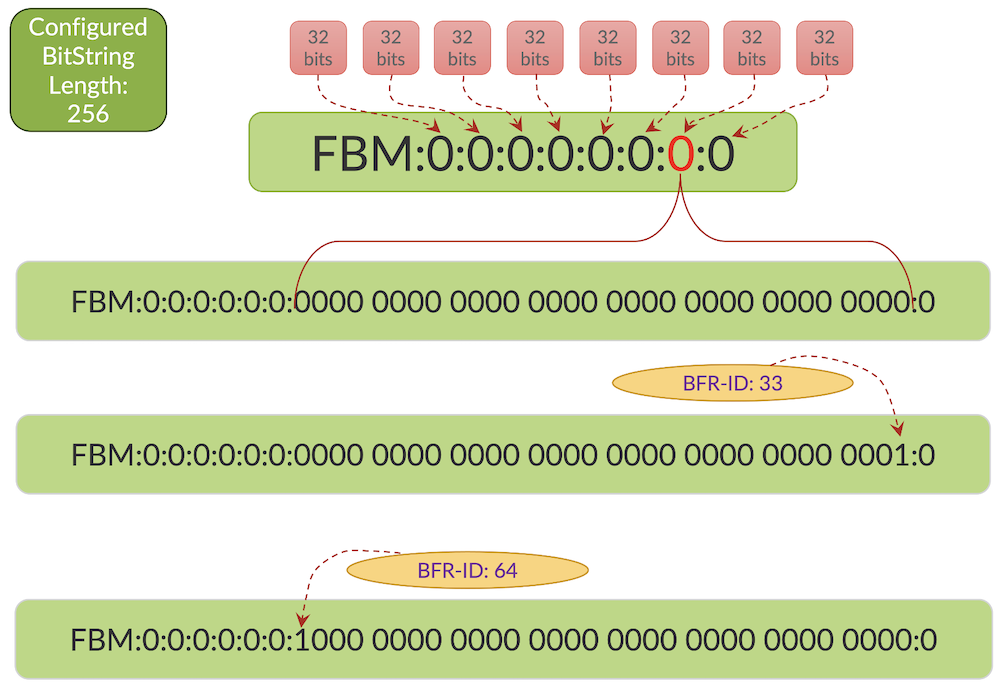
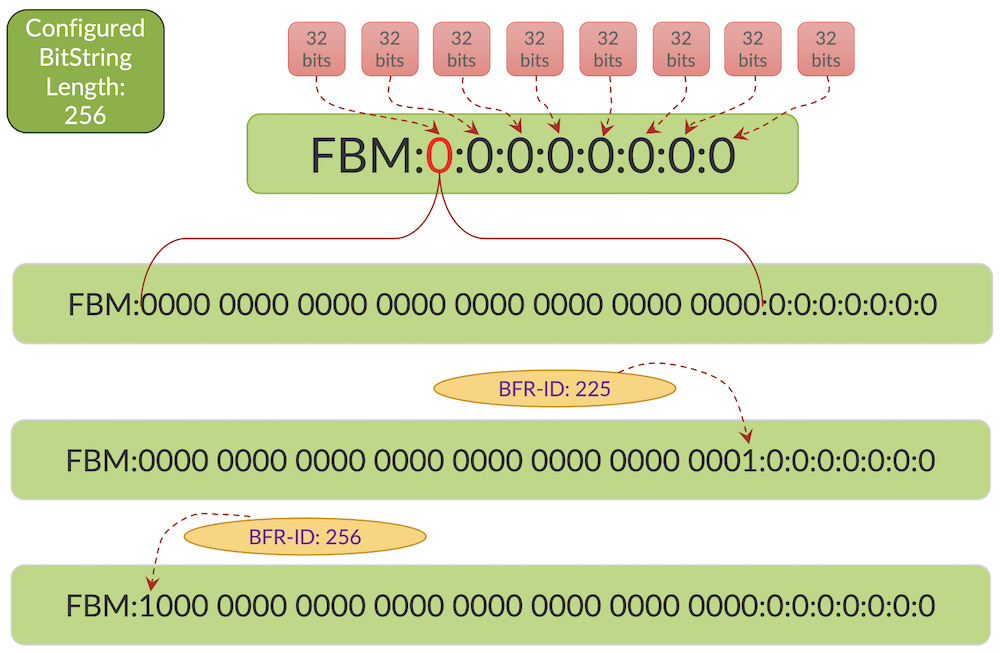
In the FBM representation, 8 values are present for a bit-string-length of 256b, and each is separated by ":", each value represents 32 BFIR/BFER.
In the following diagram, BFR-ID of 1 and 32 are represented:
In the below diagram, BFR-ID 33 and 64 are represented
BFR-ID 225 and 256 are represented as below.
BIFT-FBM with Single BIER Domain
BIFT-FBM View from BFR R2
The BFR R2 has three neighbors R1, R3, and R5 via the BFIR/BFER are reachable.
Let's take the FBM with Neighbor 11.1.1.3 ie, FBM:0:0:0:0:0:0:0:00000068. The same can be represented as FBM:0:0:0:0:0:0:0:000000 0110 1000, where 6 is decoded as 0110 and 8 as 1000. Here BFIR/BFER Router's R4, R6, and R7 are reachable via R3.
BIFT-FBM View from BFIR/BFER R1
The BFIR/BFER R1 has a single neighbor R2 and all other BFIR/BFERs are reachable through it.
The FBM string FBM:0:0:0:0:0:0:0:00000078 can be represented as FBM:0:0:0:0:0:0:0:000000 0111 1000, where 7 is decoded as 0111 and 8 as 1000. Ie BFIR/BFER's R4, R5, R6 and R7 are reachable via R2.
BIFT-FBM with multiple BIER Sub-Domains
For each sub-domain, set one BIFT table will be created.
BIFT-FBM View at BFIR/BFER(R1)
Here, two sub-domains 100 and 200 are displayed. The first one having entire BFIR/BFERs are in the same set, whereas in sub-domain 200, BFIR/BFER R1 and R7 are in one set, and others are in a different set.
From BFIR/BFER R1 perspective, there is only one next-hop R2 hence only one FBM was created for each of the BFERs (R4, R5, R6, R7) for sub-domain 200.
BIFT-FBM View at BFR (R2)
The BFR R2 has three neighbors R1, R3, and R5. As all
As BFIR/BFER R7 (bfr-id:7) is reachable via both R3 (11.1.1.3) and R5 (11.1.1.5), and we could see two FBM values.
BIER Layer
The BIER layer has the FBM information for each of the BFER for each of the forwarding next-hop routers. The FBM is AND with the BitString of the Multicast packet to figure out the next forwarding router.
The BIER header packet structure as per the RFC-8279 is as follows:
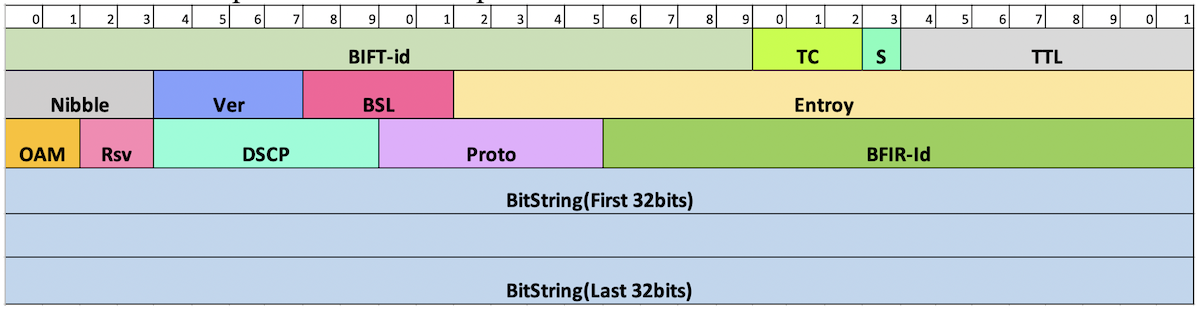
BIER Packet Header
The first 32 bits constituting the BIFT-id, TC, S, TTL are the same as that of an MPLS label structure, the first 20 bits BIFT-id is the BIER label, which uniquely identifies the table to look for the FBM to send the multicast packet to various destinations.
BIFT Table Lookup
The BIER label in the multicast packet is matched on the mpls.0 table to identify the IGP topology and sub-domain and the set. Once the set is identified, the BitString in the BIER header is processed on the corresponding BIFT table.
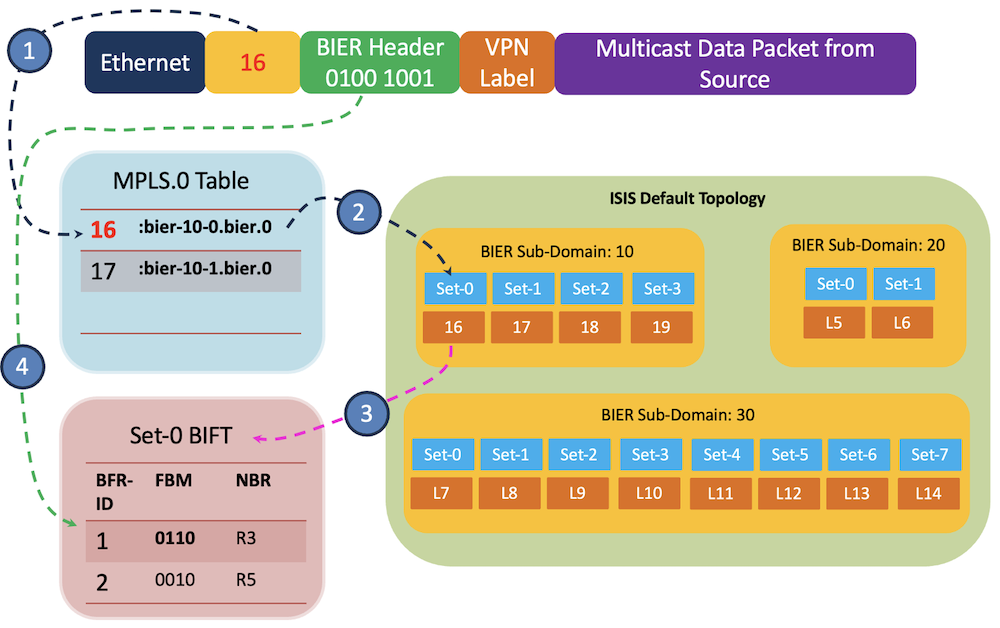
BIFT Lookup in BFR
When MPLS encapsulation is used with BIER, the first 20 bits of the BIER header correspond to an MPLS label. On a Transit router, based on the BIER label, the BIFT is identified and the incoming packet's BitString is updated. There is a separate BIFT per "sub-domain" and "Set".
In PTX10002-36QDD, based on the BIER packet's entropy field, one of the PFEs is chosen for the processing of the packet.
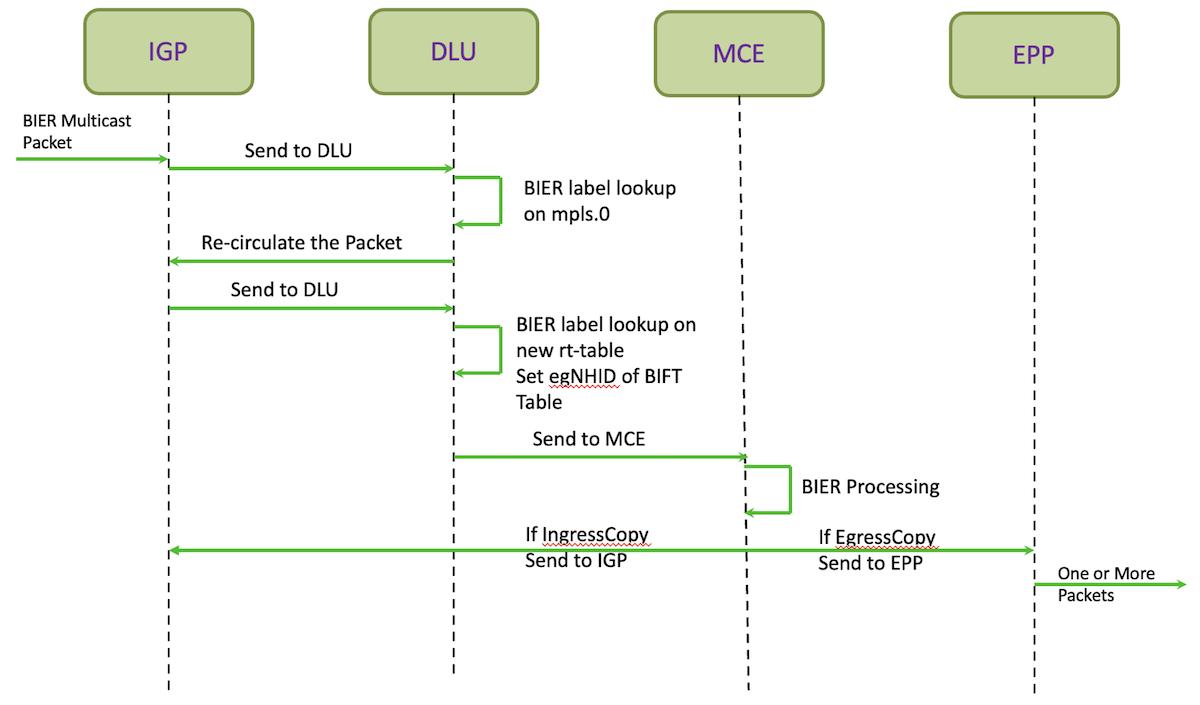
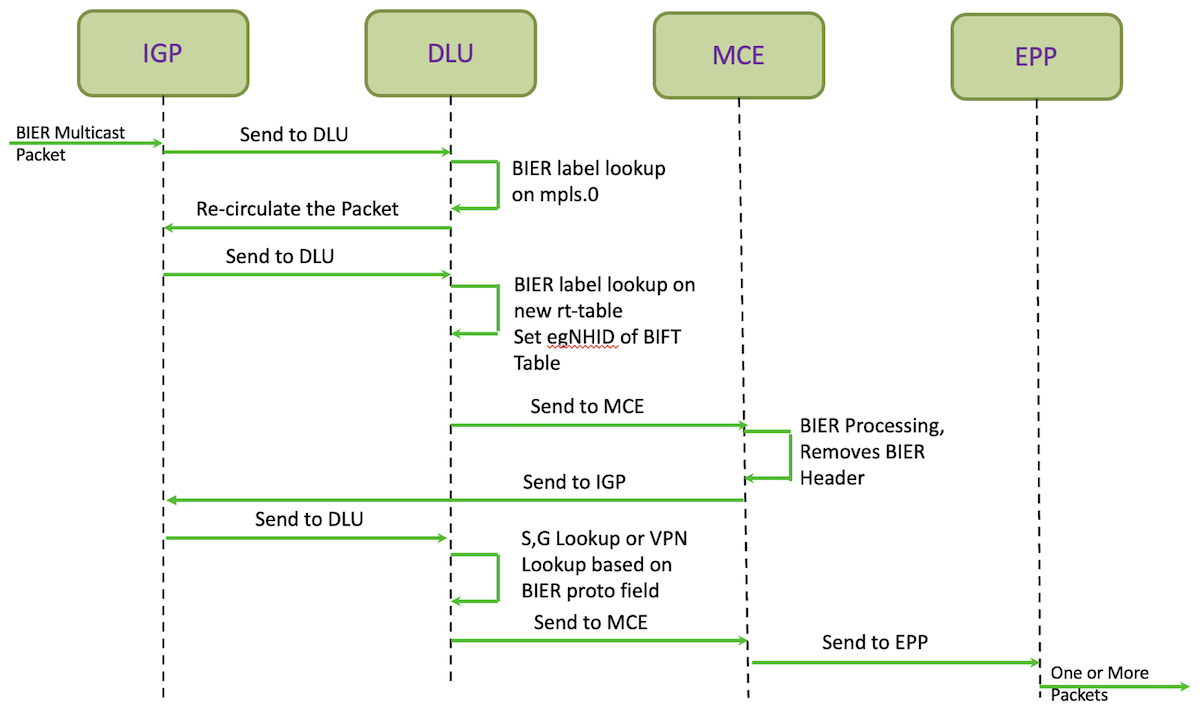
In Express platforms, there are two ways to program multicast flow. Any multicast flow whose replication can be handled locally to the PFE is achieved using "EgressCopy". If a multicast flow whose final egress PFE is not the current PFE uses "IngressCopy" to send the packet back to IGP so that it can be sent across the fabric to another PFE.
In the following diagram, we will see the different places where lookup is performed based on different scenarios:
- Ingress Parser (IGP)
- Destination LookUp (DLU)
- Multicast Engine (MCE)
- Egress Packet Processor (EPP)
The BIER multicast flow in a BFR within the Express platform follows the following sequences.
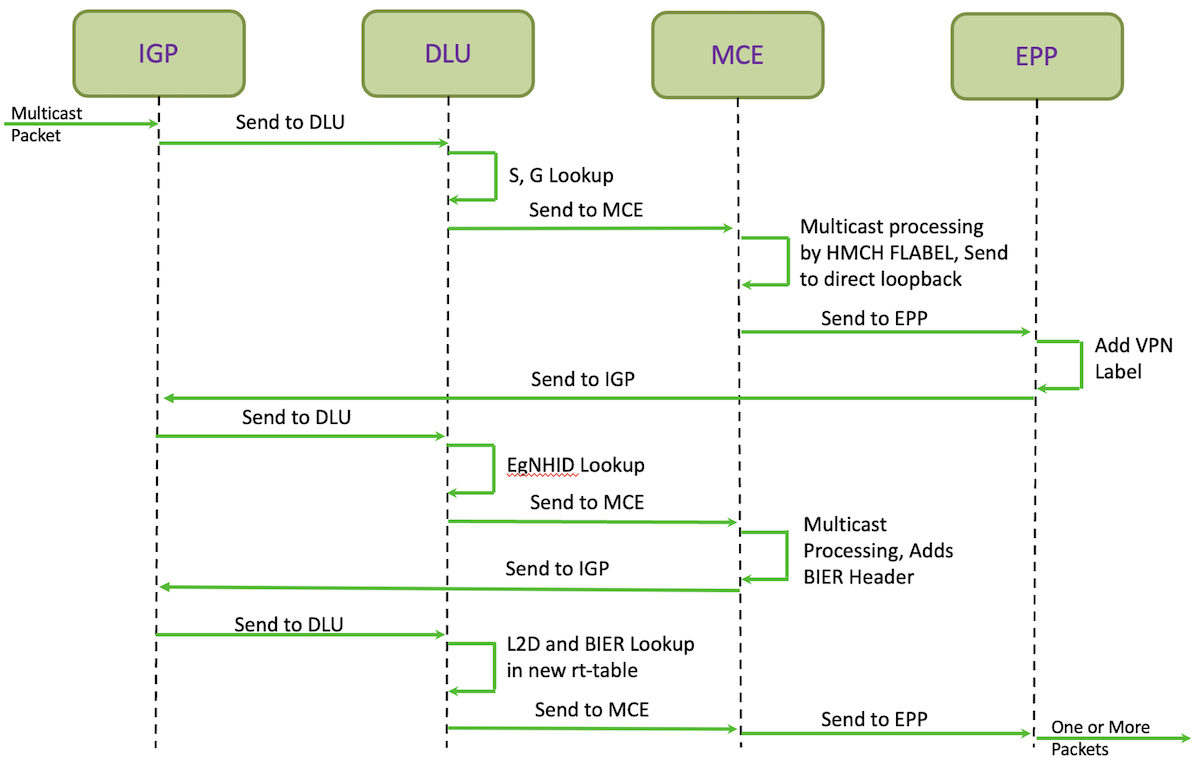
BIFT Lookup in BFIR
When a multicast packet enters a BIER domain, the BFIR determines the packet's "sub-domain" and the "set of egress routers" to which the packet needs to be forwarded. It encapsulates the packet with a "BIER header" which contains a BitString. Each bit in the BitString represents an egress router to which the multicast packet needs to be forwarded to.
BIFT Lookup in BFER
On a BFER, the BIER header needs to be removed and traditional multicast processing must be done based on the inner multicast IP header. As the incoming packet is a BIER packet with a BIER header, BFTR processing is done. The recirculation path cannot be skipped for BFER. MCE engine removes the BIER header and loops the packet back to IGP. Regular multicast processing based on the inner packet is done after that.
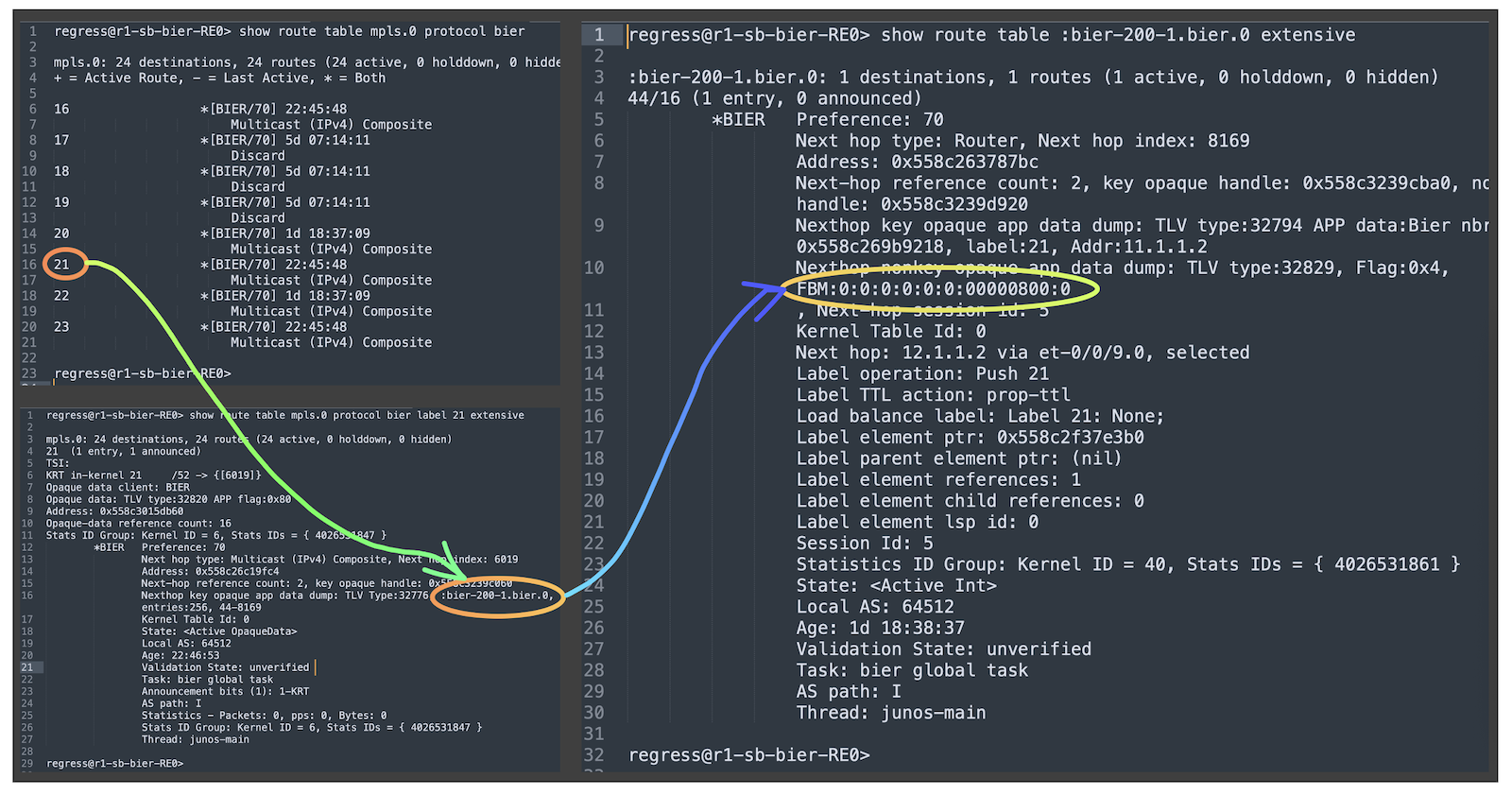
Let's look into one of the BIFT Label and its subsequent table lookup, here we are checking the BIFT Label -- 21, the mpls.0 table gives the BIFT, which returns the FBM used for checking the BIER header to identify the interested BFER and its next-hops.
Useful links
RFC/Drafts
- https://datatracker.ietf.org/doc/rfc8279/
- https://datatracker.ietf.org/doc/rfc8296/
- https://datatracker.ietf.org/doc/rfc8401/
- https://datatracker.ietf.org/doc/rfc8556/
- https://datatracker.ietf.org/doc/draft-ietf-bess-mvpn-evpn-aggregation-label/14/
- https://www.rfc-editor.org/rfc/rfc7902.html
PTX10002-36QDD:
- https://juniper.github.io/techposts/introducing-ptx10002-36qdd/article
- https://juniper.github.io/techposts/express-5-overview/article
- https://www.juniper.net/us/en/products/routers/ptx-series/ptx10002-36qdd-packet-transport-router.html
BIER TechPost Articles
- https://juniper.github.io/techposts/bier-introduction-and-underlay/article
- https://juniper.github.io/techposts/bier-overlay/article
- https://juniper.github.io/techposts/bier-mvpn-in-ptx-express-5/article
- https://juniper.github.io/techposts/eantc-bier-interop-testing-on-ptx10002-36qdd/article
EANTC 2024 InterOP Report
Glossary
- BIER: Bit Index Explicit Replication
- BFR: Bit Forwarding Router
- BFR-NBR: BFR Neighbor
- BFR-Prefix: BFR Prefix IP address
- BFER: Bit Forwarding Egress Router
- BFIR Bit Forwarding Ingress Router
- BIRT: Bit Index Routing Table
- BIFT: Bit Index Forwarding Table
- BML: Bit Mask Length
- BSL: Bit String Length
- BFR-Id: BFR Identifier
- BGP: Border Gateway Protocol
- DCB: Domain-wide Common Block
- DLU: Destination Lookup
- EANTC: European Advanced Networking Test Center
- EPP: Egress Packet Processor
- FBM: Forwarding Bit Mask
- IGMP: Internet Group Management Protocol
- IGP: Interior Gateway Protocol
- IGP: Ingress Parser
- ISIS: Intermediate System Intermediate System
- LDP: Label Distribution Protocol
- LSA: Link State Advertisement
- MCE: Multicast Engine
- m-LDP: Multicast LDP
- MPLS: Multi Protocol Label Switching
- MVPN: Multicast VPN
- MWC: MPLS World Congress
- OSPF: Open Shortest Path First
- PIM: Protocol Independent Multicast
- PMSI: Provider Multicast Service Interface
- RFC: Request For Comments
- RSVP-TE: Resource Reservation Protocol -- Traffic Engineering
- VRF: Virtual Routing and Forwarding
- VPN: Virtual Private Network
Acknowledgments
Thanks To: Jeffrey Zhang, Vinod Kumar Nagaraj, Venkatesan Parthasarathi, Poorna Pushkala Balasubramanian, Sambasiva Rao p,Antoni Przygienda, Nicolas Fevrier, Vasily Mukhin, Sanoj Vivekanandan, Dmitry Shokarev, Krzysztof Szarkowicz