Let's highlight the flexibility of Multi-Node High Availability (MNHA) and JUNOS while providing design considerations when implementing MNHA in a hybrid deployment model.
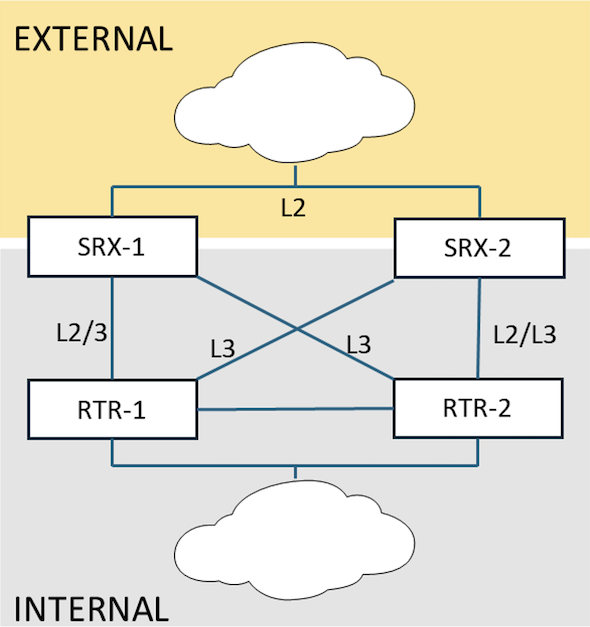
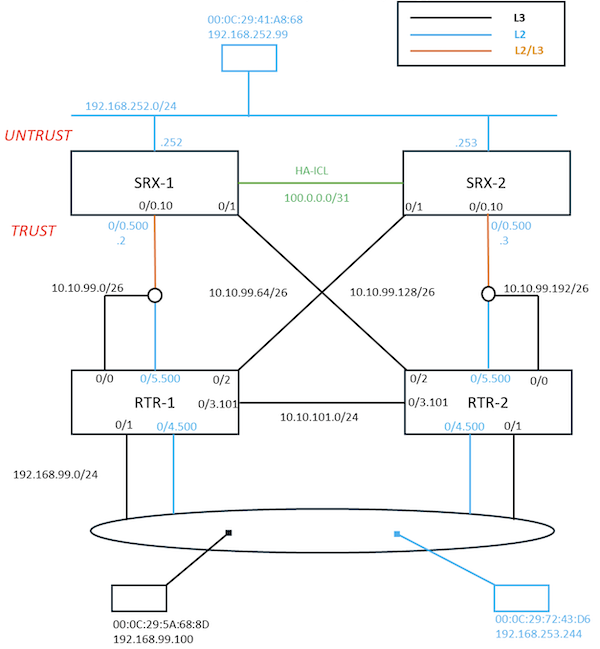
High level topology (Figure 1) represents a topology having a Layer 2 (L2) hand-off to an external network, a Layer 3 (L3) internal hand-off demarcated by a pair of SRXs. MNHA hybrid designs provide flexibility of L2 hand-offs (internal/external). Objectives validated:
RTRs (RTR-1 and RTR-2) send L3 untagged packets (routed) to the SRXs (SRX-1 and SRX-2)
RTRs also send L2 tagged packet to the SRXs (SRXs will provide default gateway functionality)
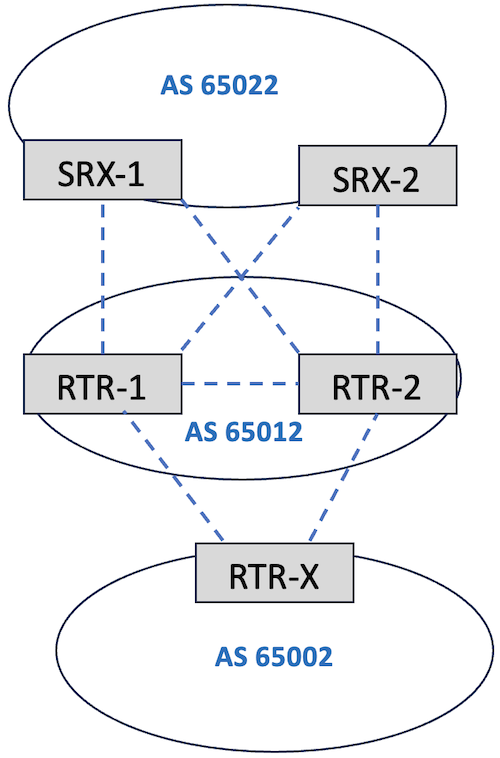
RTRs have redundant connections, crossed (bowtie) with the SRXs
Northbound connections from the SRXs provide default gateway functionality with the external network.
High availability (HA) implementation with fast stateful failover.
MNHA-RTR-1> show configuration protocols bgp | display set
set protocols bgp group EXT type external
set protocols bgp group EXT multihop ttl 4
set protocols bgp group EXT local-address 192.168.99.178
set protocols bgp group EXT local-as 65012
set protocols bgp group EXT multipath multiple-as
set protocols bgp group EXT bfd-liveness-detection minimum-interval 500
set protocols bgp group EXT bfd-liveness-detection multiplier 3
set protocols bgp group EXT neighbor 192.168.99.1 peer-as 65002
set protocols bgp group INT type internal
set protocols bgp group INT export NHS
set protocols bgp group INT local-as 65012
set protocols bgp group INT bfd-liveness-detection minimum-interval 500
set protocols bgp group INT bfd-liveness-detection minimum-receive-interval 500
set protocols bgp group INT bfd-liveness-detection multiplier 3
set protocols bgp group INT neighbor 10.10.101.2
set protocols bgp group INT-ebgp type external
set protocols bgp group INT-ebgp local-as 65012
set protocols bgp group INT-ebgp bfd-liveness-detection minimum-interval 500
set protocols bgp group INT-ebgp bfd-liveness-detection multiplier 3
set protocols bgp group INT-ebgp bfd-liveness-detection holddown-interval 10000
set protocols bgp group INT-ebgp neighbor 10.10.99.131 peer-as 65022
set protocols bgp group INT-ebgp neighbor 10.10.99.5 peer-as 65022
MNHA-RTR-2> show configuration protocols bgp | display set
set protocols bgp group unINT type external
set protocols bgp group unINT local-address 192.168.99.179
set protocols bgp group unINT local-as 65012
set protocols bgp group unINT multipath multiple-as
set protocols bgp group unINT bfd-liveness-detection minimum-interval 500
set protocols bgp group unINT bfd-liveness-detection minimum-receive-interval 500
set protocols bgp group unINT bfd-liveness-detection multiplier 3
set protocols bgp group unINT neighbor 192.168.99.1 peer-as 65002
set protocols bgp group INT type internal
set protocols bgp group INT export NHS
set protocols bgp group INT local-as 65012
set protocols bgp group INT bfd-liveness-detection minimum-interval 500
set protocols bgp group INT bfd-liveness-detection multiplier 3
set protocols bgp group INT neighbor 10.10.101.1
set protocols bgp group INT-ebgp local-as 65012
set protocols bgp group INT-ebgp bfd-liveness-detection minimum-interval 500
set protocols bgp group INT-ebgp bfd-liveness-detection multiplier 3
set protocols bgp group INT-ebgp bfd-liveness-detection holddown-interval 10000
set protocols bgp group INT-ebgp neighbor 10.10.99.69 peer-as 65022
set protocols bgp group INT-ebgp neighbor 10.10.99.195 peer-as 65022
MNHA-SRX-1> show configuration protocols bgp | display set
set protocols bgp group trust type external
set protocols bgp group trust export MNHA_ROUTE_POLICY
set protocols bgp group trust local-as 65022
set protocols bgp group trust multipath
set protocols bgp group trust bfd-liveness-detection minimum-interval 500
set protocols bgp group trust bfd-liveness-detection minimum-receive-interval 500
set protocols bgp group trust bfd-liveness-detection multiplier 3
set protocols bgp group trust bfd-liveness-detection holddown-interval 10000
set protocols bgp group trust neighbor 10.10.99.1 peer-as 65012
set protocols bgp group trust neighbor 10.10.99.65 peer-as 65012
MNHA-SRX-2> show configuration protocols bgp | display set
set protocols bgp group trust type external
set protocols bgp group trust export MNHA_ROUTE_POLICY
set protocols bgp group trust local-as 65022
set protocols bgp group trust multipath multiple-as
set protocols bgp group trust bfd-liveness-detection minimum-interval 500
set protocols bgp group trust bfd-liveness-detection multiplier 3
set protocols bgp group trust bfd-liveness-detection holddown-interval 10000
set protocols bgp group trust neighbor 10.10.99.129 peer-as 65012
set protocols bgp group trust neighbor 10.10.99.193 peer-as 65012
The signal routes are arbitrary and installed locally to the SRXs. However, do not use active prefixes in your environment as this may cause unwanted connectivity issues with those production prefixes. The signal routes used are 169.254.200.1/32 (active) and 169.254.200.2/32 (backup).
set chassis high-availability services-redundancy-group 1 active-signal-route 169.254.200.1
set chassis high-availability services-redundancy-group 1 backup-signal-route 169.254.200.2
(Signal route configuration)
The active (highest activeness priority) will install the "active" signal route while the backup (lowest activeness priority) will install the "backup" signal route in the respective local routing tables.
The active SRX (SRX-1) installs the active signal route 169.254.200.1 and does not have an entry for the backup signal route 169.254.200.2.
The export policy will advertise the 192.168.252.0/24 prefix to respective BGP peers with specified MED if the active route (10) or backup route (20) are present in the routing table.
The policy options and conditions are configured identically on the SRXs.
MNHA-SRX-1> show configuration | display set | grep MNHA_
set policy-options policy-statement MNHA_ROUTE_POLICY term 1 from protocol direct
set policy-options policy-statement MNHA_ROUTE_POLICY term 1 from route-filter 192.168.252.0/24 exact
set policy-options policy-statement MNHA_ROUTE_POLICY term 1 from condition ACTIVE_ROUTE_EXISTS_SRG1
set policy-options policy-statement MNHA_ROUTE_POLICY term 1 then metric 10
set policy-options policy-statement MNHA_ROUTE_POLICY term 1 then accept
set policy-options policy-statement MNHA_ROUTE_POLICY term 2 from protocol direct
set policy-options policy-statement MNHA_ROUTE_POLICY term 2 from route-filter 192.168.252.0/24 exact
set policy-options policy-statement MNHA_ROUTE_POLICY term 2 from condition BACKUP_ROUTE_EXISTS_SRG1
set policy-options policy-statement MNHA_ROUTE_POLICY term 2 then metric 20
set policy-options policy-statement MNHA_ROUTE_POLICY term 2 then accept
set policy-options policy-statement MNHA_ROUTE_POLICY term 99 from protocol direct
set policy-options policy-statement MNHA_ROUTE_POLICY term 99 then metric 30
set policy-options policy-statement MNHA_ROUTE_POLICY term 99 then accept
set policy-options policy-statement MNHA_ROUTE_POLICY term default then reject
set protocols bgp group trust export MNHA_ROUTE_POLICY
(Export Policy)
RTR-1 preferred route to 192.168.252.0/24 is to SRX-1 (active -- best metric) and RTR-2 preferred route to 192.168.252.0/24 is also to SRX-1 (active -- best metric). If the link (BGP peers) from either RTR-1 or RTR-2 to SRX-1 fails, traffic will be routed across the cross connection between RTR-1 and RTR-2 to reach SRX-1.
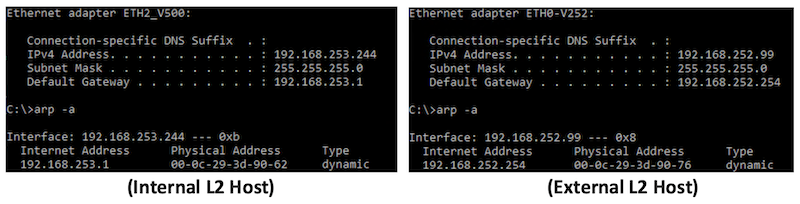
The active SRX will use 192.168.253.1 for VLAN 500 and will use 192.168.252.254 for the north bound L2 hand-off. A failover event will trigger a GARP advertisement to update the connected switching tables when the IP moves from the previously active SRX to the newly active SRX.
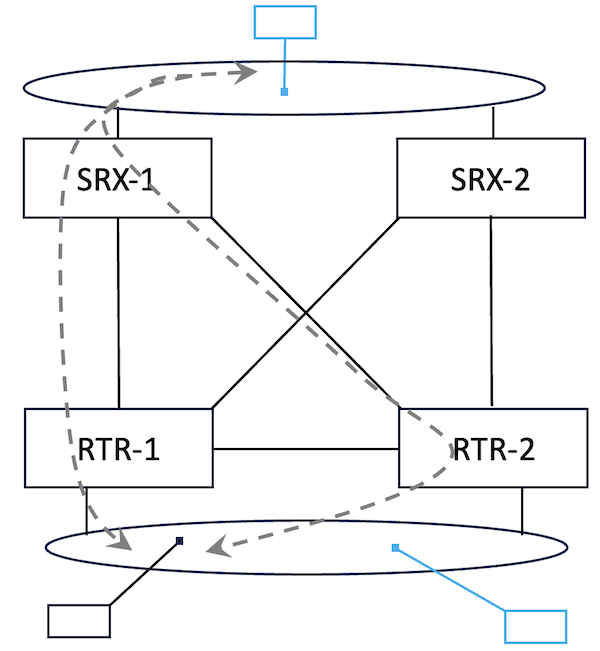
Traffic flows during a normalized state, with SRX-1 as the active node, traffic will first hit the hosts' respective default gateways. For the MNHA-L3 flow (Figure 6), the SRX-1 has an ECMP route to the destination and flows will be routed accordingly.
Figure 6: MNHA-L3 Traffic Flow
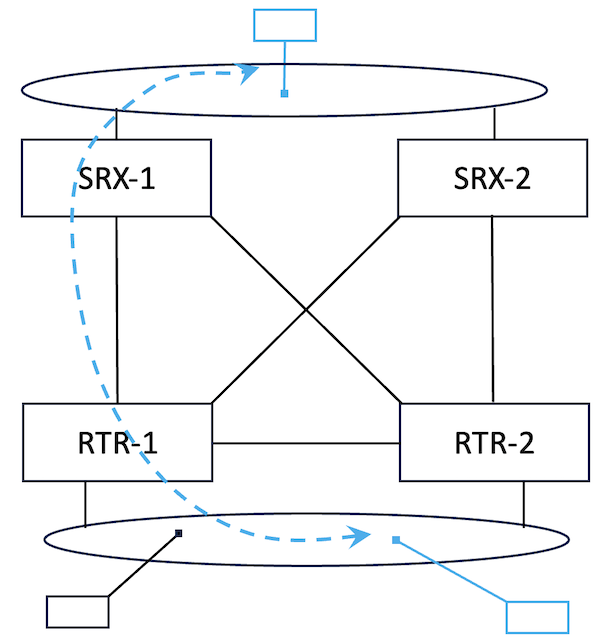
With the MNHA-DFG (Figure 7) scenario, return traffic (or originating traffic) from 192.168.253.244 will be sent to its default gateway on the active SRX.
Figure 7: MNHA-DFG Traffic Flow
During failover testing, a L3 flow is represented as a long-lived (TCP 5202) session from 192.168.99.100, internal - behind RTR-X, to 192.168.252.99, external. An** L2 flow** is represented as a long-lived (TCP 5201) session from 192.168.253.244, internal, to 192.168.252.99, external.
Sessions on the active SRX will be installed in the table with an HA Wing state of Active. Session information, under normalized conditions:
If there is failure on the active forwarding path in the bow-tie design, traffic will be instantly routed across the cross connect between RTR-1 and RTR-2 (MED 10) and a failover event will not occur as shown below with the change of interface on session (ID 119130) from 0/0/0.10 to 0/0/1.0. The L2 forwarding paths were not changed (0/0/0.500).
With an active fault condition, single BFD session down between SRX-1 and RTR-1, the backup SRX session table remains unchanged; no failover event triggered.
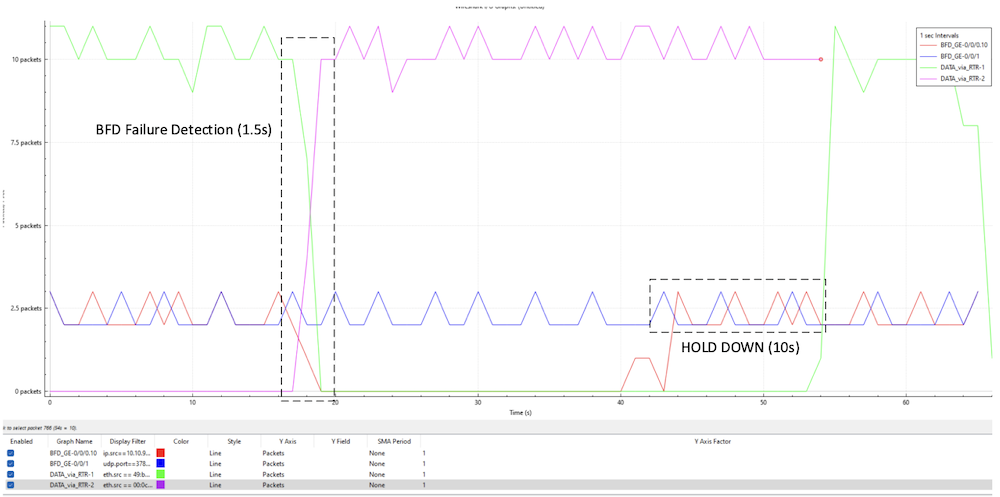
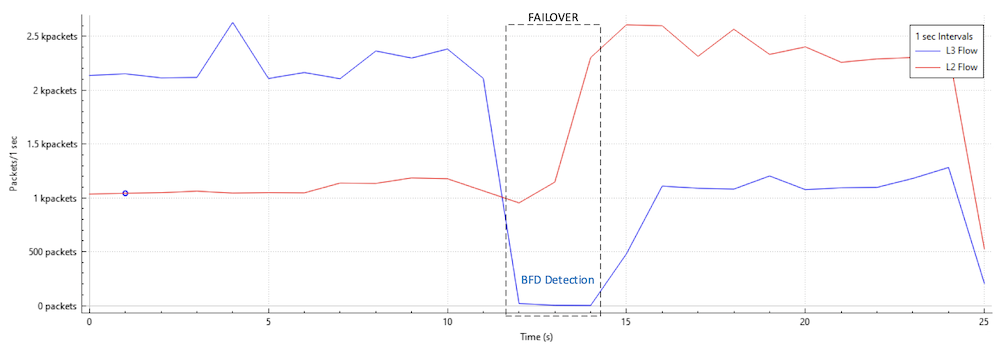
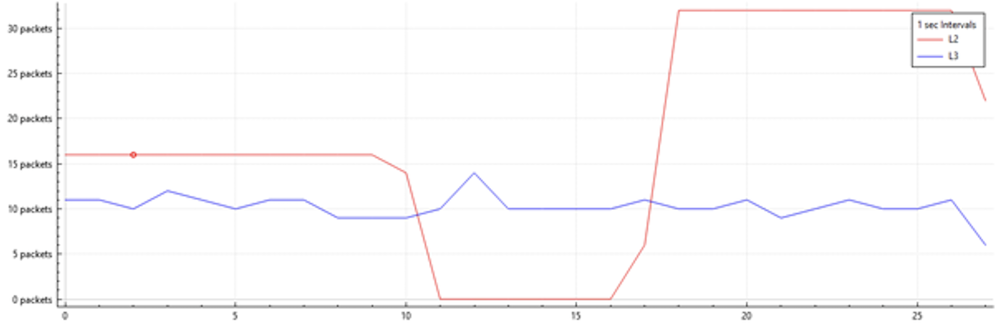
If both redundant BFD sessions fail, a failover event is triggered (Figure 8). The initially active SRX (SRX-1) transitions into an Ineligible state while the previously backup SRX (SRX-2) moves into the active state. The sessions transition from Warm to Active on the newly active SRX-2 and vice versa for SRX-1.
Figure 8 visualizes the BFD detection time, impacting L3 traffic for 1.5 seconds.
Figure 8: BFD triggered Failover
Failover Event -- Reboot Active Node and Split-Brain Detection
With hybrid deployments, when there is impact to the ICL connectivity, for example losing power to the active node, the mechanism to tell the backup SRX for an SRG group to transition to active is gone. Once the configurable detection time expires, 2 seconds in these scenarios, either an ICMP or BFD based split-brain detection initializes. Split-brain detection is leveraged to ensure that there is not an opportunity for the VIP to be active on both SRXs (duplicate IP address) and negatively impacting traffic flows.
ICMP activeness is the default method for split-brain detection. The following example uses a 1 second probe, requiring 3 failed responses to declare the SRX as active for the VIP -- triggering the GARP process (if previously backup for the SRG). The default gateway, VIP, move can have an impact to traffic between 3-8 seconds with ICMP detection.
set chassis high-availability services-redundancy-group 1 activeness-probe minimum-interval 1000
set chassis high-availability services-redundancy-group 1 activeness-probe multiplier 3
(ICMP Activeness Configuration)
Figure 9: Reboot Active SRG SRX ICMP Based
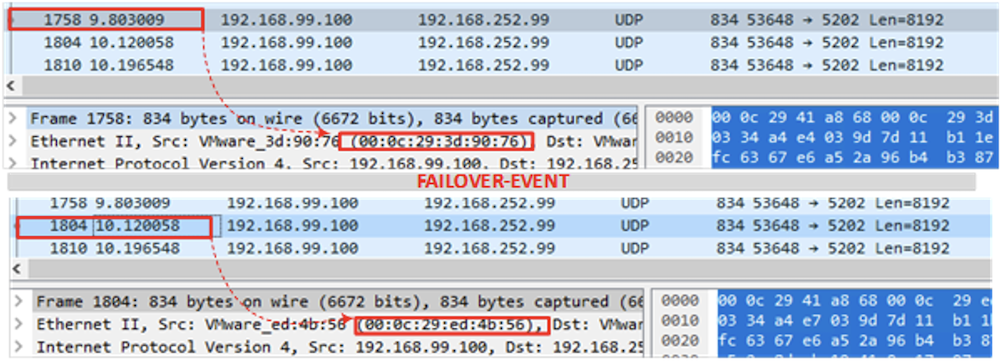
Notice that L3 traffic, traffic routed towards the destination versus switched, was not impacted. The interfaces were hard down during the reboot, traffic routed from SRX-1 (00:0C:29:3D:90:76) to 192.168.252.99 via SRX-2 (00:0C:29:ED:4B:56) (Figure 10).
Figure 10: Reboot Active SRG SRX - L3 flow
Single-hop BFD is an alternative to ICMP based split-brain detection. While ICMP based split-brain detection initiates after an ICL failure is detected, BFD is constantly running on the SRG and can achieve quicker default gateway failovers. Be aware that you can not configure both ICMP and BFD split-brain detections simultaneously.
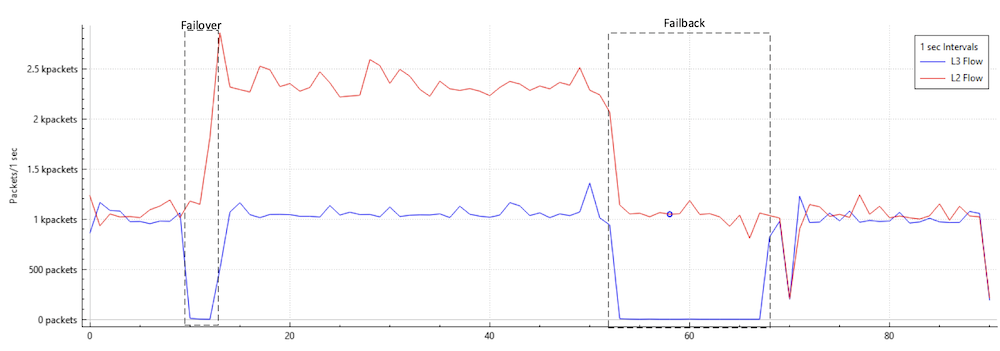
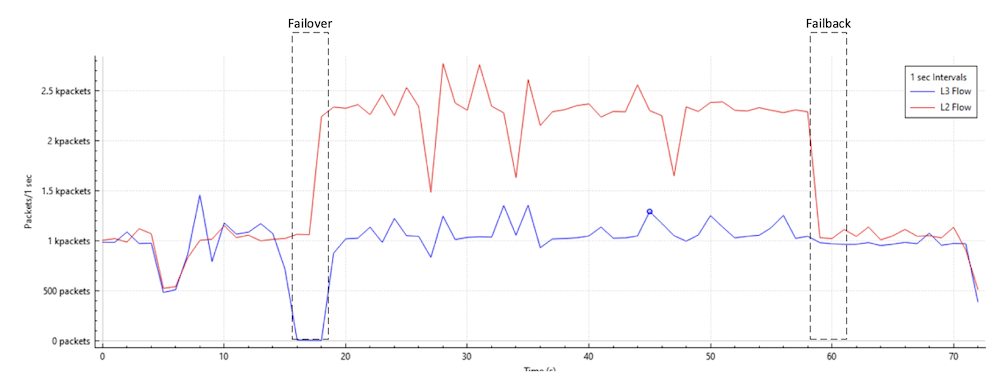
With preemption, there is an automatic fail-back once the monitoring criteria is met. The BFD BGP hold-down timer mentioned previously is simply used to illustrate potential convergence/instability issues along the active SRXs forwarding path(s). In the following example (Figure 11), SRX-1 preempts becoming active. L2 traffic is not impacted (with interface failover). However, the L3 traffic is impacted by the duration of the hold-down timer (10s); the BGP peers are not up while SRX-1 is active.
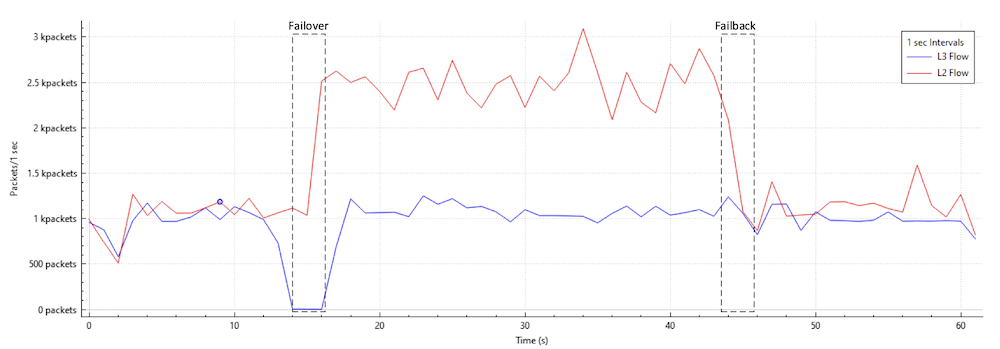
Failover event graphs were from packet captures taken on 192.168.252.99 (L2 external host).
Figure 11: Preempt Failover/Failback with hold-down
Figure 12 shows the same traffic flows during failover and a preempted failback, without the BGP BFD hold-down timer configured.
Figure 12: Preempt Failover/Failback without hold-down
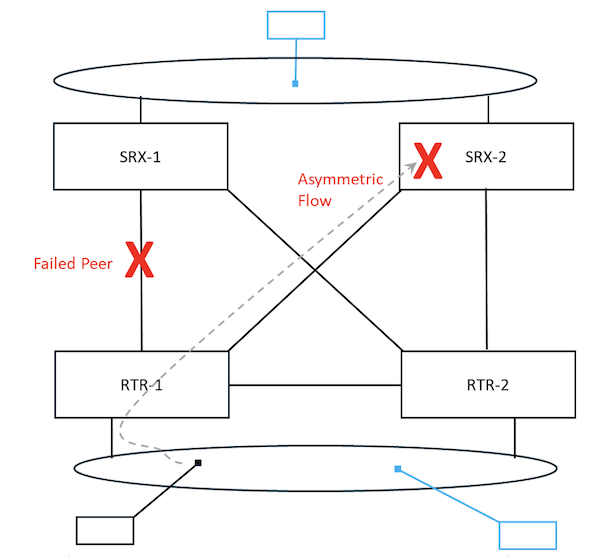
Under normalized operations, no failed links, a bow-tie design with iBGP and MNHA operates as expected -- symmetrical traffic to the active SRX. However, there may be an issue during an active failed link event without any additional design considerations. For example, if there was a BGP peer failure on the active forwarding path, let's say RTR-1 to SRX-1, traffic will not flow across the inter-connect between RTR-1 and RTR-2 to reach SRX-1. Instead, traffic will flow from the link between RTR-1 to SRX-2 (backup SRX) creating an asymmetric flow and causing stateful flows to break. This is due to BGP's loop prevention, preventing iBGP peers from forwarding iBGP learned prefixes (SRX-1/2) to other iBGP neighbors (RTR-1/2).
Figure 14: Asymmetrical Traffic Flow
To mitigate stateful traffic disruptions during an active failed path, with an iBGP bowtie configuration, implement an IGP with appropriate redistribution or a "floating static route" between RTR-1 and RTR-2. Another mitigation method is to use ICD (Inter Chassis Datapath) link(s).
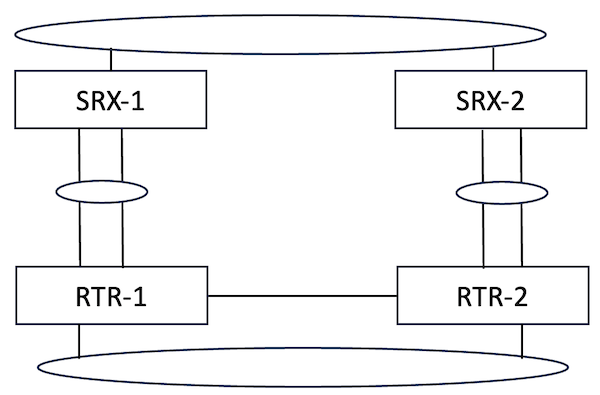
The same level of physical redundancy can be achieved by deploying 802.11ad (LACP) aggregate interfaces (Figure 15) between the routers and SRXs without "crossing" the links. Instead of ECMP load-balancing, the load-balancing would be with the LAG's hashing algorithm.
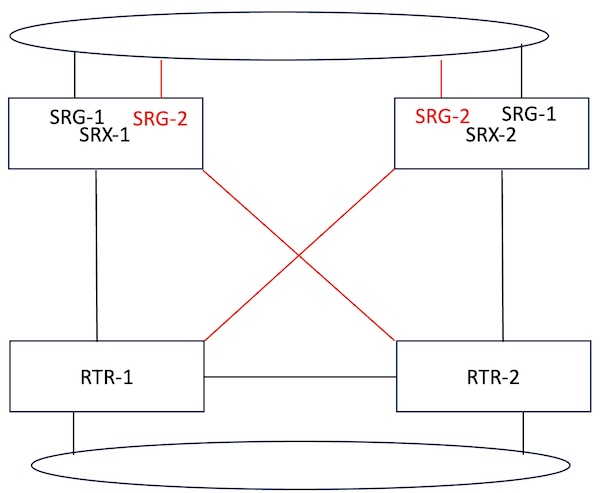
Another alternative would be to use 2 SRGs (Service Redundancy Groups) in an active/active (Figure 16) scenario such that the redundant L3 links from the routers are split between the 2 groups. This would also require an additional VIP.
set system host-name MNHA-RTR-1
set system no-redirects
set security forwarding-options family inet mode packet-based
set interfaces ge-0/0/0 unit 0 family inet address 10.10.99.1/26
set interfaces ge-0/0/1 unit 0 family inet address 192.168.99.178/24
set interfaces ge-0/0/2 unit 0 family inet address 10.10.99.129/26
set interfaces ge-0/0/3 flexible-vlan-tagging
set interfaces ge-0/0/3 unit 101 vlan-id 101
set interfaces ge-0/0/3 unit 101 family inet address 10.10.101.1/24
set interfaces ge-0/0/3 unit 201 vlan-id 201
set interfaces ge-0/0/3 unit 201 family inet address 10.10.201.1/24
set interfaces ge-0/0/4 flexible-vlan-tagging
set interfaces ge-0/0/4 native-vlan-id 500
set interfaces ge-0/0/4 unit 0 family ethernet-switching interface-mode trunk set interfaces ge-0/0/4 unit 0 family ethernet-switching vlan members V500
set interfaces ge-0/0/5 flexible-vlan-tagging
set interfaces ge-0/0/5 unit 0 family ethernet-switching interface-mode trunk
set interfaces ge-0/0/5 unit 0 family ethernet-switching vlan members V500
set interfaces fxp0 unit 0 family inet address 192.168.100.178/24
set interfaces lo0 unit 101 family inet address 10.11.11.12/32
set interfaces lo0 unit 201 family inet address 10.11.201.1/32
set policy-options policy-statement NHS term 1 from protocol bgp
set policy-options policy-statement NHS term 1 from route-type external
set policy-options policy-statement NHS term 1 then next-hop self
set policy-options policy-statement load-balancing-policy then load-balance per-flow
set protocols bgp group EXT type external
set protocols bgp group EXT multihop ttl 4
set protocols bgp group EXT local-address 192.168.99.178
set protocols bgp group EXT local-as 65012
set protocols bgp group EXT multipath multiple-as
set protocols bgp group EXT bfd-liveness-detection minimum-interval 500
set protocols bgp group EXT bfd-liveness-detection multiplier 3
set protocols bgp group EXT neighbor 192.168.99.1 peer-as 65002
set protocols bgp group INT type internal
set protocols bgp group INT export NHS
set protocols bgp group INT local-as 65012
set protocols bgp group INT bfd-liveness-detection minimum-interval 500
set protocols bgp group INT bfd-liveness-detection minimum-receive-interval 500
set protocols bgp group INT bfd-liveness-detection multiplier 3
set protocols bgp group INT neighbor 10.10.101.2
set protocols bgp group INT-ebgp type external
set protocols bgp group INT-ebgp local-as 65012
set protocols bgp group INT-ebgp bfd-liveness-detection minimum-interval 500
set protocols bgp group INT-ebgp bfd-liveness-detection multiplier 3
set protocols bgp group INT-ebgp bfd-liveness-detection holddown-interval 10000
set protocols bgp group INT-ebgp neighbor 10.10.99.131 peer-as 65022
set protocols bgp group INT-ebgp neighbor 10.10.99.5 peer-as 65022
set routing-options static route 192.168.99.100/32 next-hop 192.168.99.1
set routing-options forwarding-table export load-balancing-policy
set vlans V500 vlan-id 500
set vlans VLAN101 vlan-id 101
set system host-name MNHA-RTR-2
set system no-redirects
set security forwarding-options family inet mode packet-based
set interfaces ge-0/0/0 unit 0 family inet address 10.10.99.193/26
set interfaces ge-0/0/1 unit 0 family inet address 192.168.99.179/24
set interfaces ge-0/0/2 unit 0 family inet address 10.10.99.65/26
set interfaces ge-0/0/3 flexible-vlan-tagging
set interfaces ge-0/0/3 unit 101 vlan-id 101
set interfaces ge-0/0/3 unit 101 family inet address 10.10.101.2/24
set interfaces ge-0/0/3 unit 201 vlan-id 201
set interfaces ge-0/0/3 unit 201 family inet address 10.10.201.2/24
set interfaces ge-0/0/4 flexible-vlan-tagging
set interfaces ge-0/0/4 native-vlan-id 500
set interfaces ge-0/0/4 unit 0 family ethernet-switching interface-mode trunk
set interfaces ge-0/0/4 unit 0 family ethernet-switching vlan members V500
set interfaces ge-0/0/5 flexible-vlan-tagging
set interfaces ge-0/0/5 unit 0 family ethernet-switching interface-mode trunk
set interfaces ge-0/0/5 unit 0 family ethernet-switching vlan members V500
set interfaces fxp0 unit 0 family inet address 192.168.100.179/24
set interfaces lo0 unit 101 family inet address 10.11.11.11/32
set policy-options policy-statement NHS term 1 from protocol bgp
set policy-options policy-statement NHS term 1 from route-type external
set policy-options policy-statement NHS term 1 then next-hop self
set policy-options policy-statement load-balancing-policy then load-balance per-flow
set protocols bgp group EXT type external
set protocols bgp group EXT local-address 192.168.99.179
set protocols bgp group EXT local-as 65012
set protocols bgp group EXT multipath multiple-as
set protocols bgp group EXT bfd-liveness-detection minimum-interval 500
set protocols bgp group EXT bfd-liveness-detection minimum-receive-interval 500
set protocols bgp group EXT bfd-liveness-detection multiplier 3
set protocols bgp group EXT neighbor 192.168.99.1 peer-as 65002
set protocols bgp group INT type internal
set protocols bgp group INT export NHS
set protocols bgp group INT local-as 65012
set protocols bgp group INT bfd-liveness-detection minimum-interval 500
set protocols bgp group INT bfd-liveness-detection multiplier 3
set protocols bgp group INT neighbor 10.10.101.1
set protocols bgp group INT-ebgp local-as 65012
set protocols bgp group INT-ebgp bfd-liveness-detection minimum-interval 500
set protocols bgp group INT-ebgp bfd-liveness-detection multiplier 3
set protocols bgp group INT-ebgp bfd-liveness-detection holddown-interval 10000
set protocols bgp group INT-ebgp neighbor 10.10.99.69 peer-as 65022
set protocols bgp group INT-ebgp neighbor 10.10.99.195 peer-as 65022
set routing-options static route 192.168.99.100/32 next-hop 192.168.99.1
set routing-options forwarding-table export load-balancing-policy
set vlans V500 vlan-id 500
set vlans VLAN101 vlan-id 101
set system host-name MNHA-SRX-1
set chassis high-availability local-id 1
set chassis high-availability services-redundancy-group 1 activeness-probe minimum-interval 1000
set chassis high-availability services-redundancy-group 1 activeness-probe multiplier 3
set chassis high-availability local-id local-ip 100.0.0.0
set chassis high-availability peer-id 2 peer-ip 100.0.0.1
set chassis high-availability peer-id 2 interface ge-0/0/3.0
set chassis high-availability peer-id 2 liveness-detection minimum-interval 400
set chassis high-availability peer-id 2 liveness-detection multiplier 5
set chassis high-availability services-redundancy-group 0 peer-id 2
set chassis high-availability services-redundancy-group 1 deployment-type hybrid
set chassis high-availability services-redundancy-group 1 peer-id 2
set chassis high-availability services-redundancy-group 1 virtual-ip 1 ip 192.168.252.254/24
set chassis high-availability services-redundancy-group 1 virtual-ip 1 interface ge-0/0/2.0
set chassis high-availability services-redundancy-group 1 virtual-ip 2 ip 192.168.253.1/24
set chassis high-availability services-redundancy-group 1 virtual-ip 2 interface ge-0/0/0.500
set chassis high-availability services-redundancy-group 1 monitor monitor-object BFD_UPLINKS object-threshold 100
set chassis high-availability services-redundancy-group 1 monitor monitor-object BFD_UPLINKS bfd-liveliness threshold 100
set chassis high-availability services-redundancy-group 1 monitor monitor-object BFD_UPLINKS bfd-liveliness destination-ip 10.10.99.1 src-ip 10.10.99.5
set chassis high-availability services-redundancy-group 1 monitor monitor-object BFD_UPLINKS bfd-liveliness destination-ip 10.10.99.1 session-type singlehop
set chassis high-availability services-redundancy-group 1 monitor monitor-object BFD_UPLINKS bfd-liveliness destination-ip 10.10.99.1 interface ge-0/0/0.10
set chassis high-availability services-redundancy-group 1 monitor monitor-object BFD_UPLINKS bfd-liveliness destination-ip 10.10.99.1 weight 50
set chassis high-availability services-redundancy-group 1 monitor monitor-object BFD_UPLINKS bfd-liveliness destination-ip 10.10.99.65 src-ip 10.10.99.69
set chassis high-availability services-redundancy-group 1 monitor monitor-object BFD_UPLINKS bfd-liveliness destination-ip 10.10.99.65 session-type singlehop
set chassis high-availability services-redundancy-group 1 monitor monitor-object BFD_UPLINKS bfd-liveliness destination-ip 10.10.99.65 interface ge-0/0/1.0
set chassis high-availability services-redundancy-group 1 monitor monitor-object BFD_UPLINKS bfd-liveliness destination-ip 10.10.99.65 weight 50
set chassis high-availability services-redundancy-group 1 monitor monitor-object L2-GWS object-threshold 100
set chassis high-availability services-redundancy-group 1 monitor monitor-object L2-GWS interface threshold 100
set chassis high-availability services-redundancy-group 1 monitor monitor-object L2-GWS interface interface-name ge-0/0/2 weight 100
set chassis high-availability services-redundancy-group 1 monitor monitor-object L2-GWS interface interface-name ge-0/0/0 weight 100
set chassis high-availability services-redundancy-group 1 monitor srg-threshold 100
set chassis high-availability services-redundancy-group 1 active-signal-route 169.254.200.1
set chassis high-availability services-redundancy-group 1 backup-signal-route 169.254.200.2
set chassis high-availability services-redundancy-group 1 activeness-priority 200
set security policies default-policy permit-all
set security zones security-zone HA-ICL host-inbound-traffic system-services all
set security zones security-zone HA-ICL host-inbound-traffic protocols all
set security zones security-zone HA-ICL interfaces ge-0/0/3.0
set security zones security-zone trust host-inbound-traffic system-services all
set security zones security-zone trust host-inbound-traffic protocols all
set security zones security-zone trust interfaces ge-0/0/1.0
set security zones security-zone trust interfaces ge-0/0/0.500
set security zones security-zone trust interfaces ge-0/0/0.10
set security zones security-zone untrust host-inbound-traffic system-services ping
set security zones security-zone untrust interfaces ge-0/0/2.0
set interfaces ge-0/0/0 flexible-vlan-tagging
set interfaces ge-0/0/0 native-vlan-id 10
set interfaces ge-0/0/0 unit 10 vlan-id 10
set interfaces ge-0/0/0 unit 10 family inet address 10.10.99.5/26
set interfaces ge-0/0/0 unit 500 vlan-id 500
set interfaces ge-0/0/0 unit 500 family inet address 192.168.253.2/24
set interfaces ge-0/0/1 unit 0 family inet address 10.10.99.69/26
set interfaces ge-0/0/2 unit 0 family inet address 192.168.252.252/24
set interfaces ge-0/0/3 mtu 1514
set interfaces ge-0/0/3 unit 0 family inet address 100.0.0.0/31
set interfaces fxp0 unit 0 family inet address 192.168.100.180/24
set interfaces lo0 unit 0 family inet address 172.16.0.1/32
set forwarding-options hash-key family inet layer-3
set forwarding-options hash-key family inet layer-4
set policy-options policy-statement MNHA_ROUTE_POLICY term 1 from protocol direct
set policy-options policy-statement MNHA_ROUTE_POLICY term 1 from route-filter 192.168.252.0/24 exact
set policy-options policy-statement MNHA_ROUTE_POLICY term 1 from condition ACTIVE_ROUTE_EXISTS_SRG1
set policy-options policy-statement MNHA_ROUTE_POLICY term 1 then metric 10
set policy-options policy-statement MNHA_ROUTE_POLICY term 1 then accept
set policy-options policy-statement MNHA_ROUTE_POLICY term 2 from protocol direct
set policy-options policy-statement MNHA_ROUTE_POLICY term 2 from route-filter 192.168.252.0/24 exact
set policy-options policy-statement MNHA_ROUTE_POLICY term 2 from condition BACKUP_ROUTE_EXISTS_SRG1
set policy-options policy-statement MNHA_ROUTE_POLICY term 2 then metric 20
set policy-options policy-statement MNHA_ROUTE_POLICY term 2 then accept
set policy-options policy-statement MNHA_ROUTE_POLICY term 99 from protocol direct
set policy-options policy-statement MNHA_ROUTE_POLICY term 99 then metric 30
set policy-options policy-statement MNHA_ROUTE_POLICY term 99 then accept
set policy-options policy-statement MNHA_ROUTE_POLICY term default then reject
set policy-options policy-statement load-balancing-policy then load-balance per-flow
set policy-options condition ACTIVE_ROUTE_EXISTS_SRG1 if-route-exists address-family inet 169.254.200.1/32
set policy-options condition ACTIVE_ROUTE_EXISTS_SRG1 if-route-exists address-family inet table inet.0
set policy-options condition BACKUP_ROUTE_EXISTS_SRG1 if-route-exists address-family inet 169.254.200.2/32
set policy-options condition BACKUP_ROUTE_EXISTS_SRG1 if-route-exists address-family inet table inet.0
set protocols bgp group trust type external
set protocols bgp group trust export MNHA_ROUTE_POLICY
set protocols bgp group trust local-as 65022
set protocols bgp group trust multipath
set protocols bgp group trust bfd-liveness-detection minimum-interval 500
set protocols bgp group trust bfd-liveness-detection minimum-receive-interval 500
set protocols bgp group trust bfd-liveness-detection multiplier 3
set protocols bgp group trust bfd-liveness-detection holddown-interval 10000
set protocols bgp group trust neighbor 10.10.99.1 peer-as 65012
set protocols bgp group trust neighbor 10.10.99.65 peer-as 65012
set routing-options forwarding-table export load-balancing-policy
set system host-name MNHA-SRX-2
set chassis high-availability local-id 2
set chassis high-availability services-redundancy-group 1 activeness-probe minimum-interval 1000
set chassis high-availability services-redundancy-group 1 activeness-probe multiplier 3
set chassis high-availability local-id local-ip 100.0.0.1
set chassis high-availability peer-id 1 peer-ip 100.0.0.0
set chassis high-availability peer-id 1 interface ge-0/0/3.0
set chassis high-availability peer-id 1 liveness-detection minimum-interval 400
set chassis high-availability peer-id 1 liveness-detection multiplier 5
set chassis high-availability services-redundancy-group 0 peer-id 1
set chassis high-availability services-redundancy-group 1 deployment-type hybrid
set chassis high-availability services-redundancy-group 1 peer-id 1
set chassis high-availability services-redundancy-group 1 virtual-ip 1 ip 192.168.252.254/24
set chassis high-availability services-redundancy-group 1 virtual-ip 1 interface ge-0/0/2.0
set chassis high-availability services-redundancy-group 1 virtual-ip 2 ip 192.168.253.1/24
set chassis high-availability services-redundancy-group 1 virtual-ip 2 interface ge-0/0/0.500
set chassis high-availability services-redundancy-group 1 monitor monitor-object BFD_UPLINKS object-threshold 100
set chassis high-availability services-redundancy-group 1 monitor monitor-object BFD_UPLINKS bfd-liveliness threshold 100
set chassis high-availability services-redundancy-group 1 monitor monitor-object BFD_UPLINKS bfd-liveliness destination-ip 10.10.99.193 src-ip 10.10.99.195
set chassis high-availability services-redundancy-group 1 monitor monitor-object BFD_UPLINKS bfd-liveliness destination-ip 10.10.99.193 session-type singlehop
set chassis high-availability services-redundancy-group 1 monitor monitor-object BFD_UPLINKS bfd-liveliness destination-ip 10.10.99.193 interface ge-0/0/0.10
set chassis high-availability services-redundancy-group 1 monitor monitor-object BFD_UPLINKS bfd-liveliness destination-ip 10.10.99.193 weight 50
set chassis high-availability services-redundancy-group 1 monitor monitor-object BFD_UPLINKS bfd-liveliness destination-ip 10.10.99.129 src-ip 10.10.99.131
set chassis high-availability services-redundancy-group 1 monitor monitor-object BFD_UPLINKS bfd-liveliness destination-ip 10.10.99.129 session-type singlehop
set chassis high-availability services-redundancy-group 1 monitor monitor-object BFD_UPLINKS bfd-liveliness destination-ip 10.10.99.129 interface ge-0/0/1.0
set chassis high-availability services-redundancy-group 1 monitor monitor-object BFD_UPLINKS bfd-liveliness destination-ip 10.10.99.129 weight 50
set chassis high-availability services-redundancy-group 1 monitor monitor-object L2-GWS object-threshold 100
set chassis high-availability services-redundancy-group 1 monitor monitor-object L2-GWS interface threshold 100
set chassis high-availability services-redundancy-group 1 monitor monitor-object L2-GWS interface interface-name ge-0/0/2 weight 100
set chassis high-availability services-redundancy-group 1 monitor monitor-object L2-GWS interface interface-name ge-0/0/1 weight 100
set chassis high-availability services-redundancy-group 1 monitor srg-threshold 100
set chassis high-availability services-redundancy-group 1 active-signal-route 169.254.200.1
set chassis high-availability services-redundancy-group 1 backup-signal-route 169.254.200.2
set chassis high-availability services-redundancy-group 1 activeness-priority 100
set security policies default-policy permit-all
set security zones security-zone HA-ICL host-inbound-traffic system-services all
set security zones security-zone HA-ICL host-inbound-traffic protocols all
set security zones security-zone HA-ICL interfaces ge-0/0/3.0
set security zones security-zone trust host-inbound-traffic system-services all
set security zones security-zone trust host-inbound-traffic protocols all
set security zones security-zone trust interfaces ge-0/0/1.0
set security zones security-zone trust interfaces ge-0/0/0.500
set security zones security-zone trust interfaces ge-0/0/0.10
set security zones security-zone untrust host-inbound-traffic system-services ping
set security zones security-zone untrust interfaces ge-0/0/2.0
set interfaces ge-0/0/0 flexible-vlan-tagging
set interfaces ge-0/0/0 native-vlan-id 10
set interfaces ge-0/0/0 unit 10 vlan-id 10
set interfaces ge-0/0/0 unit 10 family inet address 10.10.99.195/26
set interfaces ge-0/0/0 unit 500 vlan-id 500
set interfaces ge-0/0/0 unit 500 family inet address 192.168.253.3/24
set interfaces ge-0/0/1 unit 0 family inet address 10.10.99.131/26
set interfaces ge-0/0/2 unit 0 family inet address 192.168.252.253/24
set interfaces ge-0/0/3 mtu 1514
set interfaces ge-0/0/3 unit 0 family inet address 100.0.0.1/31
set interfaces fxp0 unit 0 family inet address 192.168.100.181/24
set interfaces lo0 unit 0 family inet address 172.16.0.2/32
set forwarding-options hash-key family inet layer-3
set forwarding-options hash-key family inet layer-4
set policy-options policy-statement MNHA_ROUTE_POLICY term 1 from protocol direct
set policy-options policy-statement MNHA_ROUTE_POLICY term 1 from route-filter 192.168.252.0/24 exact
set policy-options policy-statement MNHA_ROUTE_POLICY term 1 from condition ACTIVE_ROUTE_EXISTS_SRG1
set policy-options policy-statement MNHA_ROUTE_POLICY term 1 then metric 10
set policy-options policy-statement MNHA_ROUTE_POLICY term 1 then accept
set policy-options policy-statement MNHA_ROUTE_POLICY term 2 from protocol direct
set policy-options policy-statement MNHA_ROUTE_POLICY term 2 from route-filter 192.168.252.0/24 exact
set policy-options policy-statement MNHA_ROUTE_POLICY term 2 from condition BACKUP_ROUTE_EXISTS_SRG1
set policy-options policy-statement MNHA_ROUTE_POLICY term 2 then metric 20
set policy-options policy-statement MNHA_ROUTE_POLICY term 2 then accept
set policy-options policy-statement MNHA_ROUTE_POLICY term 99 from protocol direct
set policy-options policy-statement MNHA_ROUTE_POLICY term 99 then metric 30
set policy-options policy-statement MNHA_ROUTE_POLICY term 99 then accept
set policy-options policy-statement MNHA_ROUTE_POLICY term default then reject
set policy-options policy-statement load-balancing-policy then load-balance per-flow
set policy-options condition ACTIVE_ROUTE_EXISTS_SRG1 if-route-exists address-family inet 169.254.200.1/32
set policy-options condition ACTIVE_ROUTE_EXISTS_SRG1 if-route-exists address-family inet table inet.0
set policy-options condition BACKUP_ROUTE_EXISTS_SRG1 if-route-exists address-family inet 169.254.200.2/32
set policy-options condition BACKUP_ROUTE_EXISTS_SRG1 if-route-exists address-family inet table inet.0
set protocols bgp group trust type external
set protocols bgp group trust export MNHA_ROUTE_POLICY
set protocols bgp group trust local-as 65022
set protocols bgp group trust multipath multiple-as
set protocols bgp group trust bfd-liveness-detection minimum-interval 500
set protocols bgp group trust bfd-liveness-detection multiplier 3
set protocols bgp group trust bfd-liveness-detection holddown-interval 10000
set protocols bgp group trust neighbor 10.10.99.129 peer-as 65012
set protocols bgp group trust neighbor 10.10.99.193 peer-as 65012
set routing-options static route 0.0.0.0/0 next-hop 192.168.99.1
set routing-options forwarding-table export load-balancing-policy
With any high-availability design prudent planning is imperative. Understanding the requirements, goals, capabilities and integration with the network provides for a successful MNHA deployment:
Which MNHA model to deploy Layer 3, Layer 2 (Default Gateway) or Hybrid?
Active/Active or Active/Backup?
If L3, what protocols will be used to integrate with the network (eBGP, iBGP, OSPF)?
If L2, what type of fabric to integrate? Spanning Tree concerns?
Any convergence issues?
How quick to failover? Automatic Failback?
What mechanism to track for failover (BFD, IP, Interface, or combination of the 3)?
Once decided, it's just a matter of testing and configuring your deployment.