MACsec and L2PT over Non-Point-to-Point Networks in Junos
Junos 25.4R1 enhances Layer 2 Protocol Tunneling in VXLAN tunnels and traditional VLANs by introducing support for more protocols, allowing MACsec to traverse Layer 2 networks.
Overview
Media Access Control Security (MACsec) is primarily designed to provide point-to-point security on Ethernet links. It ensures data confidentiality and integrity between two directly connected devices. However, with techniques like Layer 2 Protocol Tunneling (L2PT), it's possible to extend MACsec's benefits across broader network segments, including non-point-to-point scenarios, by tunneling the MACsec-protected traffic transparently over Layer 2 networks.
MACsec is a Layer 2 protocol that provides encryption and integrity checks for Ethernet frames, offering an effective solution for protecting sensitive information from eavesdropping and tampering. Data remains confidential and unaltered as it travels across the network. MACsec uses the MACsec Key Agreement (MKA) protocol to exchange encryption keys between devices.
There are mainly two EtherTypes for MACsec:
- The EtherType 0x888E, as defined by the IEEE 802.1X standard, is crucial for MACsec as it is used for the MKA protocol, which handles encryption key exchange and security associations:
- EAPOL Frames: Used for Extensible Authentication Protocol over LAN (EAPOL) frames, which are part of the IEEE 802.1X standard.
- MACsec Key Agreement (MKA): Facilitates the exchange of encryption keys and the establishment of security associations.
- Authentication: Ensures that only authorized devices can join the network by managing authentication processes.
- Key Management: Handles the distribution and management of encryption keys necessary for securing communication.
In addition, MKA uses the destination MAC address called Nearest-non-TPMR-bridge. The Nearest non-TPMR Bridge group address (01-80-C2-00-00-03) is reserved by the IEEE as part of the IEEE 802.1Q, 802.1X, and 802.1AE standards. This address ensures that specific control frames are processed only by directly connected network bridges and not forwarded by Two-Port MAC Relays (TPMR).
- The EtherType 0x88E5, as defined by the IEEE 802.1AE standard, is used in MACsec to indicate that the frame is a MACsec frame:
- Integrity and Confidentiality: Ensure frames are not tampered with and can optionally be encrypted.
- Replay Protection: Uses packet numbers to prevent replay attacks.
- Security Associations: Manages secure channels and associations using the Tag Control Information (TCI) and Association Number (AN) fields.
These EtherTypes are essential for identifying and processing MACsec-protected frames, ensuring secure communication over Ethernet networks.
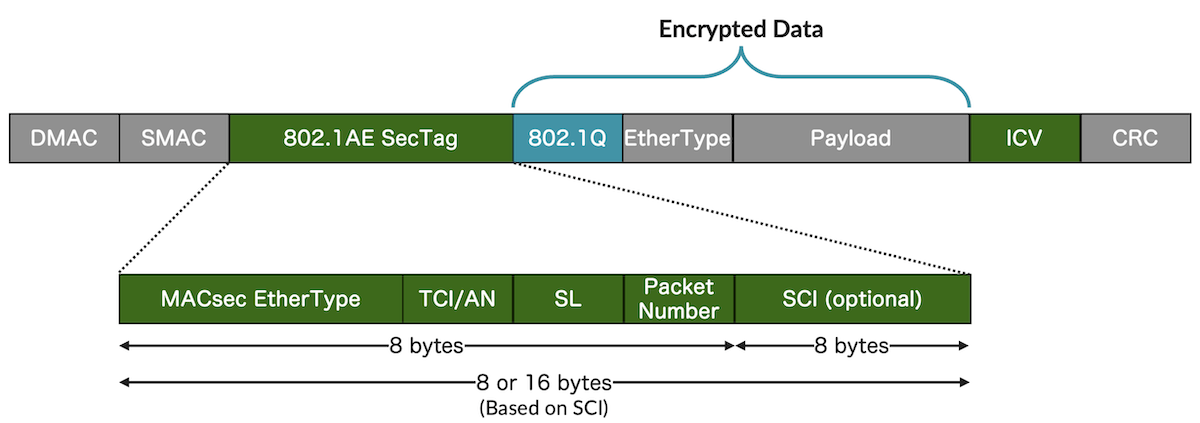
MACsec Header Structure:
- DMAC and SMAC Ethernet Header: This is the standard Ethernet frame header, which includes the destination and source MAC addresses, as well as the EtherType field (e.g., 802.1Q VLAN 0x8100).
- 802.1AE Security Tag Security tag (SecTAG): This is a MACsec-specific header that includes several fields:
- EtherType: Identifies the frame as a MACsec frame (0x88E5).
- SCI (Secure Channel Identifier): Uniquely identifies the secure channel between two devices.
- TCI (TAG Control Information): The TCI field contains several bits that provide information about the security processing of the frame, indicating
- Encryption status (E)
- Confidentiality offset (C)
- End station frame (ES)
- Secure channel (SC)
- Single copy broadcast (SCB)
- AN (Association Number): Identifies the specific security association within the secure channel.
- Packet Number (PN): A counter that ensures each frame is unique and helps prevent replay attacks.
- SL (Short Length): Indicates the length of the SecTAG and the encrypted data.
- Encrypted Data: The payload of the Ethernet frame, which is encrypted to ensure confidentiality.
- ICV (Integrity Check Value): A cryptographic checksum that ensures the integrity and authenticity of the frame.
Layer 2 Protocol Tunneling (L2PT) is a technique used to tunnel Layer 2 Control Protocol (L2CP) packets, such as Spanning Tree Protocol (STP) and Link Layer Discovery Protocol (LLDP), across a switch or router. L2PT changes the destination MAC address of these protocol packets to a predefined multicast address, allowing them to be transmitted transparently across the network without being processed by intermediate devices. This ensures that Layer 2 protocols can operate seamlessly over service provider networks.
The EtherType 0x88E5 is transparently forwarded natively in Junos OS and therefore does not need to be included in the L2PT.
Configuration
MACsec High-level Config Syntax
L2PT Configuration Syntax
Enable L2 protocol tunneling for layer 2 interfaces
Enable L2 protocol tunneling in vxlan-tunnel
Optional
Debug Tools / Show Commands
MACsec over Direct Connect
Starting with Junos OS 15.1, Juniper added support for Media Access Control Security (MACsec), providing point-to-point security on Ethernet links by encrypting and authenticating data between directly connected nodes, including MX, PTX, ACX, SRX, QFX, EX, and other products.
It uses the IEEE 802.1AE standard to prevent various security threats such as denial of service, man-in-the-middle attacks, and passive wiretapping.
To configure MACsec on Juniper MX Series routers, you typically enable it on the desired Ethernet interfaces and set up the connectivity association key (CAK) for secure communication. This involves specifying the CAK and connectivity association name (CKN) on both ends of the link. The MACsec Key Agreement (MKA) protocol then manages the encryption keys and ensures secure data transmission.
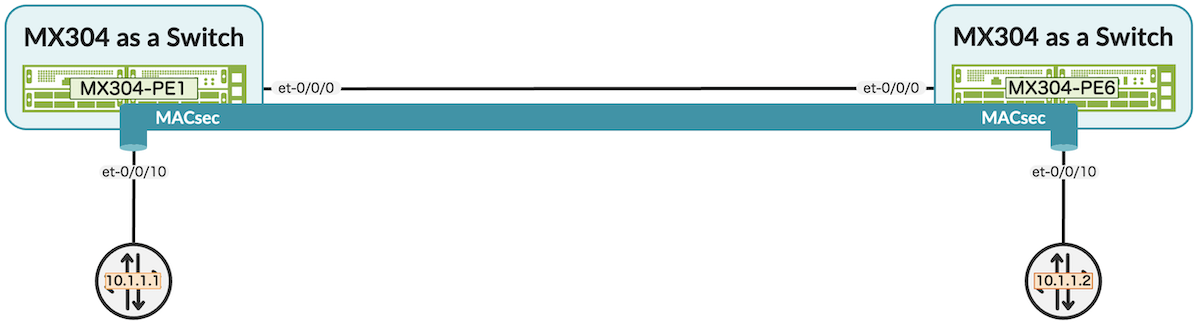
Configuring MACsec in Junos
PE1
PE2
MACsec Over Layer 2 Network
Layer 2 Protocol Tunneling (L2PT) ensures that MKA (MACsec Key Agreement) frames are forwarded transparently across the network by changing their destination MAC address to a predefined multicast address. This allows MACsec-protected traffic, including 0x888E frames, to traverse the network securely without being processed by intermediate devices. By establishing a MACsec tunnel over traditional Layer 2 networks, this technology ensures that sensitive data remains secure and confidential as it traverses the network.
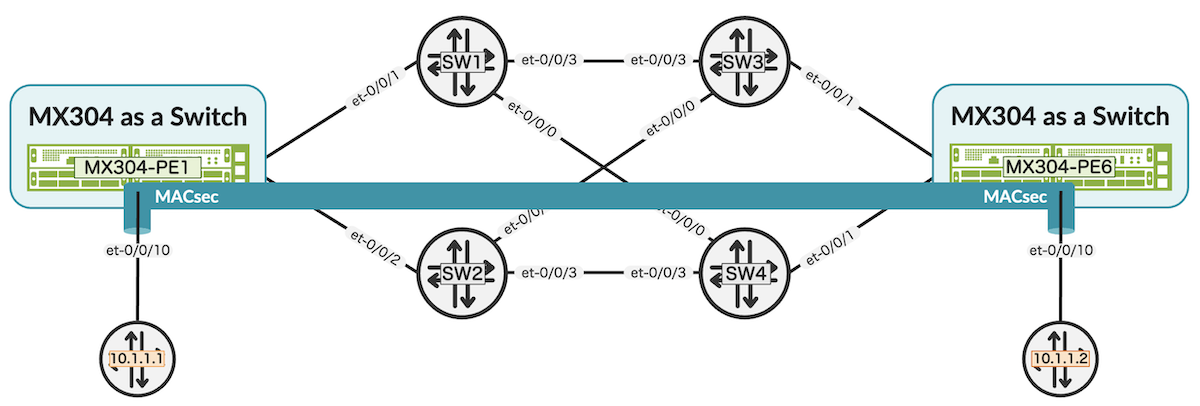
Configuring MACsec and L2PT for Transparent MACsec Tunneling
As a reminder, L2PT under layer2-control stanza is for vxlan-tunnels while mac-rewrite is for layer 2 VLAN-based interfaces.
Alternatively, we can choose to carry MACsec only where the remote side establishes the MACsec tunnel, as shown below:
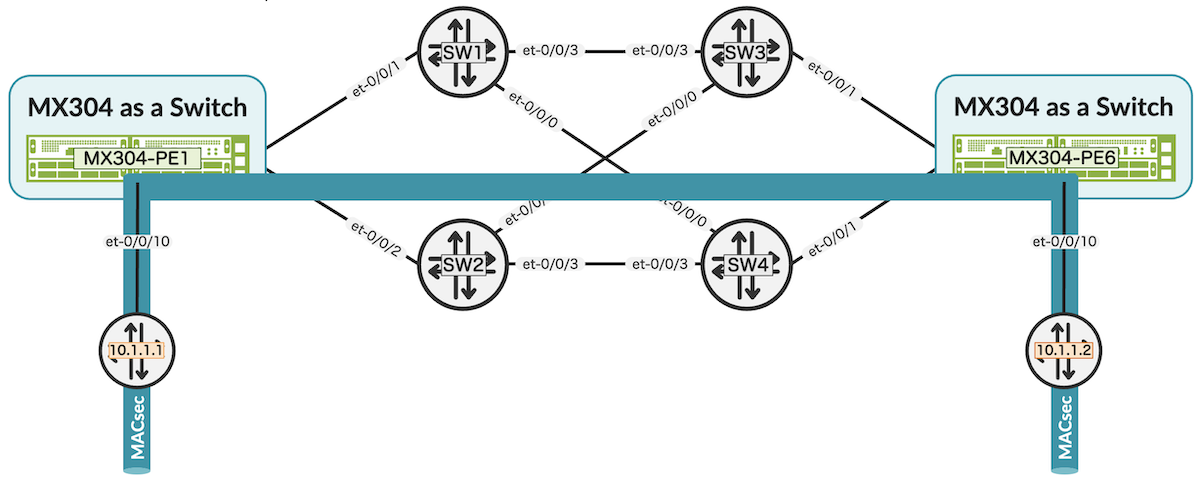
Configuring L2PT for Transparent MACsec Tunneling
Yes, it's really that effortless!
MACsec Over Layer 2 MPLS Networks
Another key use case is tunneling MACsec over MPLS VPN tunnels. Juniper, a pioneer in all L2VPN (L2VPN, VPLS, EVPN [EP-LAN Option 2], EVPN-VPWS) tunnels, offers excellent built-in support for traversing MACsec over MPLS. This capability allows the entire MACsec packet, including the 0x888E EtherType header, to be forwarded untouched, treating it as user-plane traffic. This ensures that MACsec's encryption and integrity features are preserved across the service provider's network, providing secure and transparent Layer 2 connectivity.
Note 1: The Metro Ethernet Forum (MEF) specifies the rules for processing L2CP Ethernet frames when the frames arrive at the L2CP decision point on the user network interface (UNI). The rules provide the mechanism for transparently passing the L2CP frame between a Carrier Ethernet Network and a Subscriber Network.
As Juniper products, such as the MX platform and other types of routers, comply with these rules, no additional configuration is required.
The traffic encrypted by MACsec, along with its header, will be forwarded untouched to the remote side, emulating point-to-point connectivity.
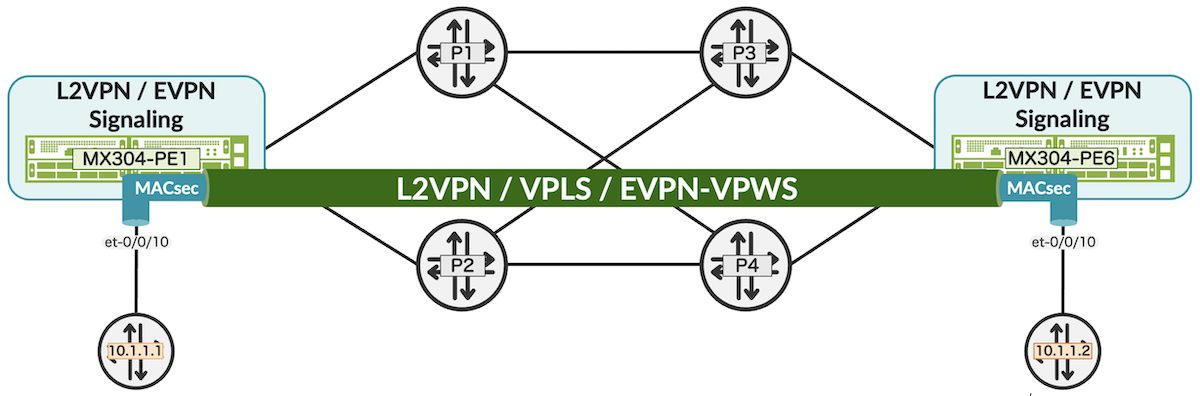
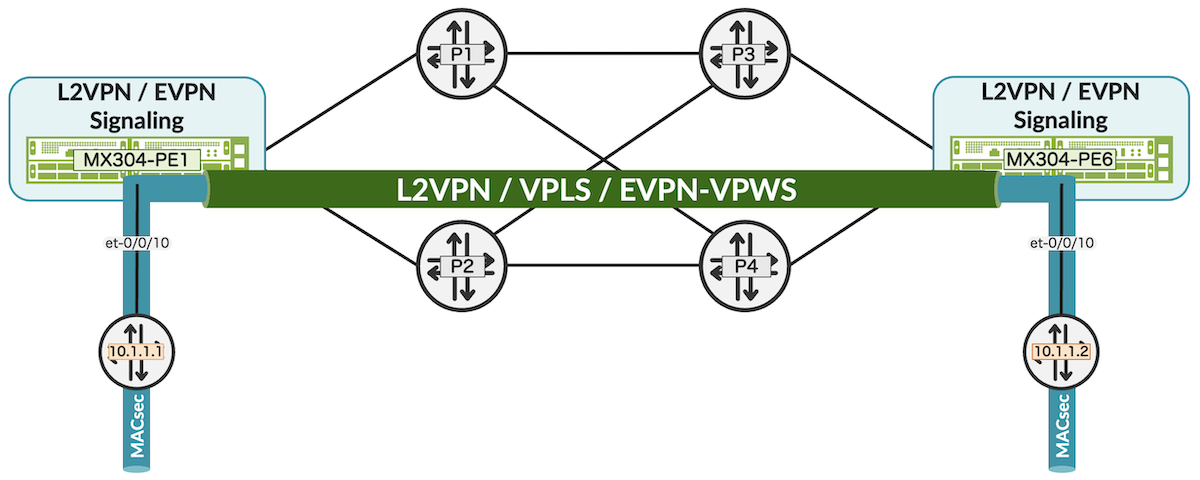
MACsec Over Layer 2 MPLS Networks with EVPN
When using an EVPN tunnel (not EVPN-VPWS), traffic is not forwarded transparently. However, Junos OS on MX routers is equipped with robust Layer 2 filtering capabilities for various families, including VPLS, MPLS, EVPN, and CCC, enabling fine-grained traffic control.
To allow MACsec to run transparently over an EVPN tunnel, we can leverage these filtering capabilities to ensure MKA multicast packets are exchanged over the tunnel. This can be achieved using either a regular filter, which controls forwarding based on the EVPN destination MAC (DMAC) table, or a flood filter, which applies to the EVPN flood table. By defining the appropriate filter, multicast traffic is permitted, allowing MACsec key negotiation to proceed without interfering with the EVPN forwarding model.
Configuring Filter or Flood for EVPN Tunnel
Or
This method is also useful for blocking specific unwanted traffic types. You can refine the filtering by selecting the exact multicast address to allow or silently discard.
Note 2: Both regular filters and flood filters are supported in VPLS.
However, an accept filter is not required for MACsec in VPLS.
Sample Decoded MACsec Packet
MACsec Key Agreement:
- Frame 1: 222 bytes on wire (1776 bits)
- Ethernet II
- 802.1Q Virtual LAN
MACsec frame: - Frame 1: 1470 bytes on wire (11760 bits) - Ethernet II - 802.1Q Virtual LAN
Useful links
- Configuring MACsec: https://www.juniper.net/documentation/us/en/software/junos/security-services/topics/task/macsec.html
Glossary
- AN: Association Number
- EAPOL: Extensible Authentication Protocol over LAN
- EVPN: Ethernet VPN
- ICV: Integrity Check Value
- IEEE: Institute of Electrical and Electronics Engineers
- L2CP: Layer 2 Control Protocol
- L2PT: Layer 2 Protocol Tunneling
- L2VPN: Layer 2 Virtual Private Network
- MACsec: Media Access Control Security
- MKA: MACSec Key Agreement
- PE: Provider Edge
- SCI: Secure Channel Identifier
- TCI: Tag Control Information
- VPLS: Virtual Private LAN Service
- UNI: User Network Interface
Acknowledgments
Special thanks to Binu S for assisting in the capture and analysis of MACsec and L2PT features.