MPC10E Deepdive
A detailed view of the MPC10E line cards used in MX240, MX480 and MX480.
MX240/480/960 product family has been Juniper's flagship product for many years. It continues to delight our customers by protecting their investments through continuous capacity upgrades without having to rip and replace the entire system. MPC10E is the latest entry in the long list of Line Cards/Modular Physical Interface Cards (MPC) supported in this family.
Introduction
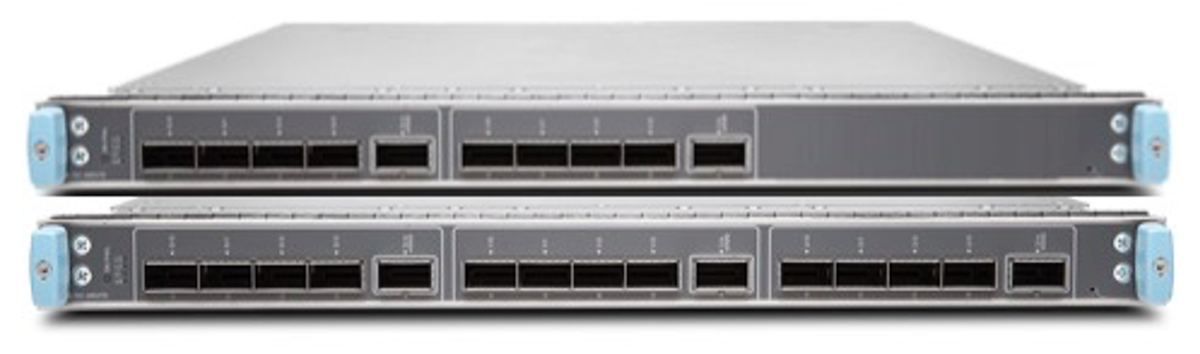
MPC10E comes in two variants, MPC10E-10c and MPC10E-15c, which can deliver 1Tbps and 1.5Tbps of throughput capacity, respectively. Each MPC10E supports different port speeds, including 400G, making it a true multi-rate or MRATE line card. Here is the summary of the speeds supported:
| Speed | MPC10E-10c | MPC10E-15c |
|---|---|---|
| 10GE | 40 (with 4x10GE Breakout) | 60 (with 4x10GE Breakout) |
| 25GE | 40 (with 4x10GE Breakout) | 60 (with 4x10GE Breakout) |
| 40GE | 10 | 15 |
| 100GE | 10 | 15 |
| 400GE | 2 | 3 |
Please find the complete list of supported optics from the Hardware Compatibility Tool:
MPC10E family of line cards runs on the fifth generation of Trio. Each line card will have two or three of these ASICs, depending on the MPC type.
Trio5 Architecture
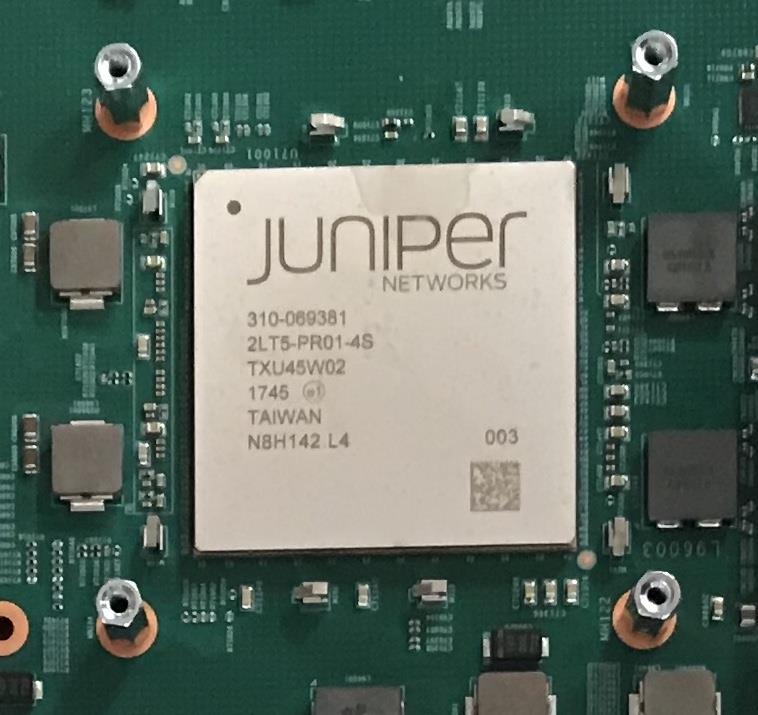
Trio5 is a 500Gbps chipset in 16nm design. Just like previous generations, Trio5 is optimized for edge deployments. The built-in crypto engine is introduced for the first time in the Trio family. This enables inline MACSec at all port speeds starting from 10GE to 100GE. 400GE MACSec is possible through Trio6. Please refer to my blog on LC9600 to get more details.
Trio5 continues to support a large scale of advanced edge features supported in the previous revisions of Trio. The same has been discussed in detail in the LC480 TechPost. It supports a high number of queues and virtually unlimited firewall filters along with prefix lists and tunnels. It supports HQoS, Inline services such as NAT, 6RD, MAP-E, and Jflow/NetFlow along with telemetry, flex-filters and up to 16 label depth to enable advanced use cases of traffic engineering with segment routing (SR/SRv6).
Trio5 is the packet forwarding engine or PFE in the MPC10E family of line cards. To optimize power and space many design considerations have been taken into account. First and foremost is the memory. Trio5 replaces the Hybrid Memory Cube (HMC) and in-house high-performance memory with High Bandwidth Memory (HBM), which is used for packet processing and WAN queuing systems. Another important difference from the previous version is the inclusion of HBM memory and Trio ASIC via a silicon interposer in 2.5D packaging design. This design reduces the bus length enabling better power performance and minimizes board area on the line cards. It helps in packing more Trio5 ASICS on a single-line card, thus improving the per-slot throughput by more than three times compared to line cards based on previous versions.
The Crypto engine has been introduced for the first time in the Trio family. It enables building power-efficient systems/line cards that won't require an external component such as PHY to secure the ethernet connections between routers and switches.
The size of on-chip memory (OCMEM) in Trio5 has been increased, which is used for on-chip delay bandwidth buffers and the WAN queuing functions.
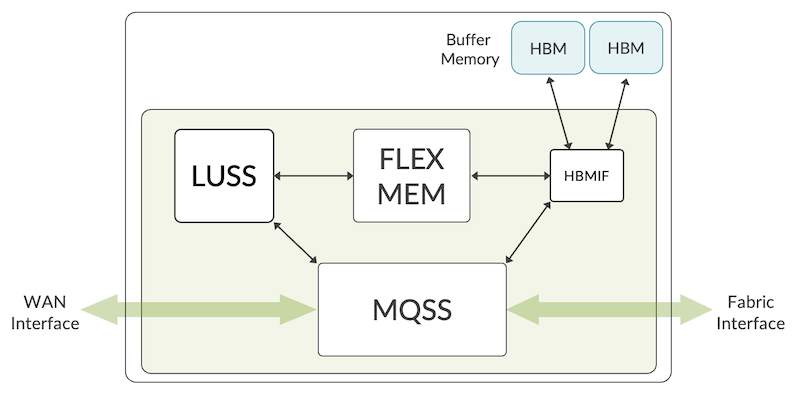
High Bandwidth Memory (HBM) is used as off-chip memory for delay bandwidth buffer and high scale flow table (Jflow) storage.
Each Trio5 has the following main components:
- Lookup SubSystem (LUSS) provides all packet processing functions such as route/label lookup, firewall, and multi-field packet classification. This subsystem holds an array of Packet Processing Engines (PPE) to perform these functions. Trio5 and Trio4 each have 96 PPE, but they run at a higher clock frequency to handle the increase in throughput in Trio5.
- Memory and Queuing SubSystem (MQSS) provides data paths and rich queuing functionality. It acts as an interface between WAN and Fabric. It has a pre-classifier where packets are classified as low/high priority. Unlike initial generations of Trio where an eXtended Queuing SubSystem (XQSS) was used to provide rich queuing functionality, Trio5 integrates this function within the MQSS block. This helps in the reduction of foot print and improves the power performance without any compromise on functionality.
- HBMIF is the interface to HBM mem and on-chip FlexMem
- FlexMem is the on-chip memory that is used for WAN queuing data structures and on-chip delay bandwidth storage.
Life of Packet inside Trio5
The life of the packet inside Trio5 is similar to the one described in Trio6 TechPost
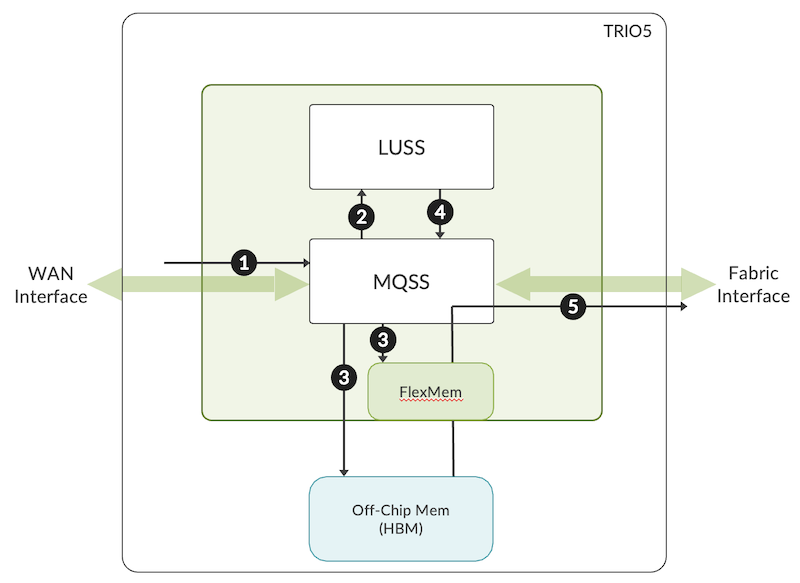
- A packet is received on the MQSS block either from the WAN interface or from the Fabric interface. Pre-classification decides priority. The main purpose of pre-classification is to make sure that high-priority control traffic is protected even if the PFE is oversubscribed.
- If the incoming packet size is less of equal to 224 bytes, the complete packet will be sent to the LUSS. If the incoming packet is larger than 224 bytes, the packet is split into HEAD (192 bytes) and TAIL. A reorder context and a reorder ID is created. Then, HEAD is sent to LUSS for processing, such as the route/label lookup function.
- The TAIL of the packet is either sent to on-chip SRAM (FlexMem) or off-chip HBM.
- The incoming packet gets processed in the PPEs in LUSS. Once LUSS has finished processing the modified packet or HEAD is sent back to MQSS. Here reorder entry of the packet is validated and once it becomes eligible it is sent to the fabric scheduler based on the priority queues.
- Once the packet becomes eligible to be sent out of PFE, the content will be read from FlexMem or HBM and the packet will be sent out via the WAN/Fabric interface.
MPC10E Architecture
The number of Packet Forwarding Engines (PFE) in MPC10E depends on the flavour. If it is a 1Tbps MPC10E-10c line card, then it will have two Trio5s, and if it is MPC10e-15c, then it will have three Trio5s. The 15c variant will have a slightly different approach in connecting to the fabric. More on this will be discussed in the next section. Leaving this aside, both the line cards have similar architecture.
Here is MPC10E-15c installed in the MX480 chassis.
The faceplate of the line card will have 15/10G optical slots. Each of these slots can, by default, support 100G speed. Only the fifth, tenth and fifteenth ports can support 400G speed.
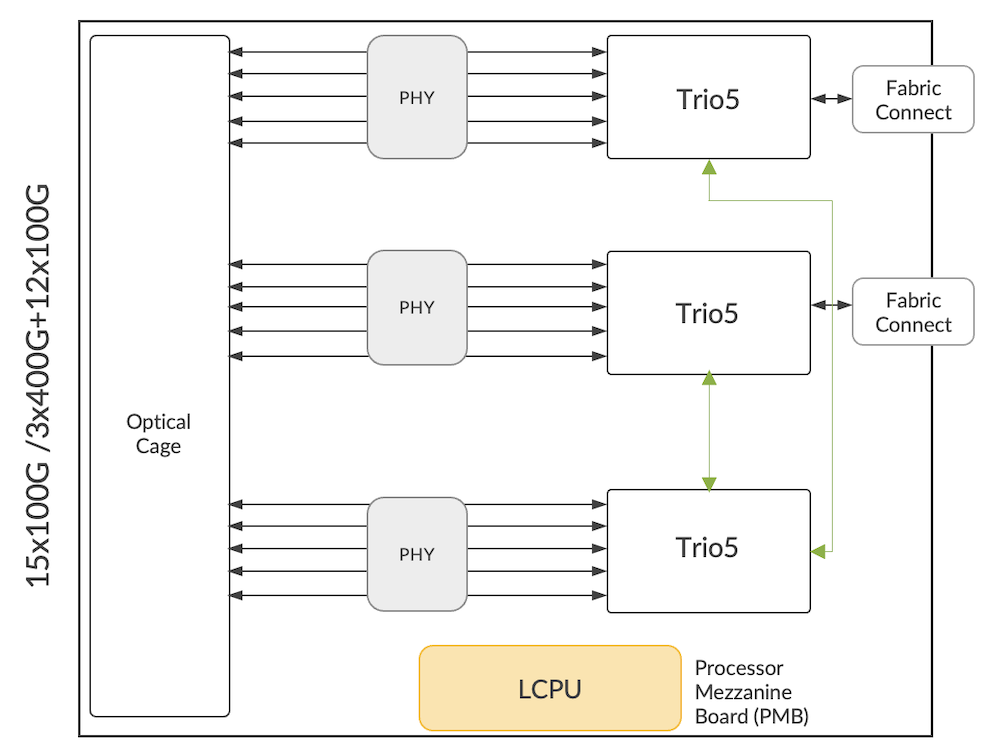
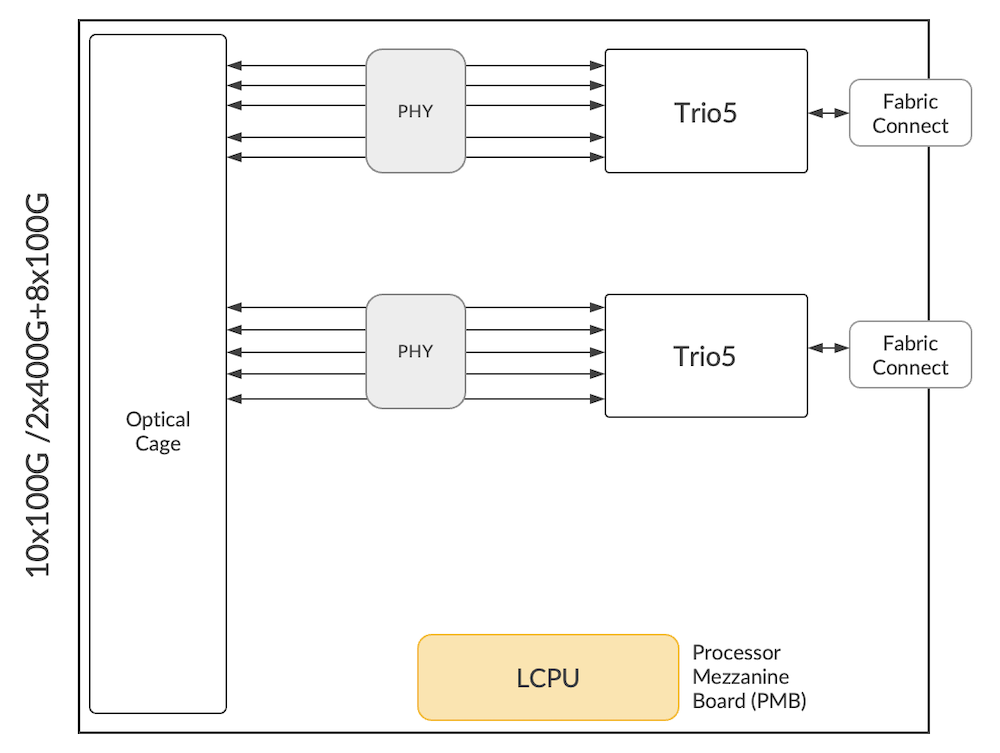
Line Card CPU (LCPU) is installed on a Processor Mezzanine Board (PMB) and serves for the standard Line card and PFE management functions. Eight core LCPU supports the bandwidth requirements of both the control and data plane. The LCPU runs the control packets and maintains other functions, such as:
- Update local route tables
- LOG, SYSLOG
- SFLOW
- JFLOW
- MACSec key exchanges
- Other bandwidth-intensive applications such as protocol session traffic, exception traffic handling, ARP, IPv4/IPv6 options etc.
There are 28 usable SerDes lanes between the ASIC and the WAN. But only 20 will be active at any given time, providing an aggregate bandwidth of 500Gbps. These SerDes lanes run at different speeds to support WAN interfaces from 10G to 400G.
MPC10E uses port profiles to manage the PIC ports. Since oversubscription is not supported on MPC10E a port profile selects a set of ports active in a PIC and the port speed. Here are the config options.
MPC10E also provides an option to control the speed at the port level. Any change in the port speed will not require a PIC bounce.
The MPC10E-10c/15c will work with fabric card SCBE3 on MX240/480 and MX960 systems. Customers can continue to use most of the legacy line cards with this fabric, including 16x10GE line cards based on 1st gen Trio. Here is the list of hardware that will interoperate with MPC10E and SCBE3.
| FRU | Interoperability |
|---|---|
| MPC1E/MPC2E/ICHIP DPC/MS-DPC | No |
| SCB/SCBE/SCBE2 | No |
| RE-1300/RE-1200 | No |
| 16x10GE MPC | Yes, with new enhanced midplane |
| MPC3E/MPC4E/MPC5E | Yes |
| NG-MPC2E/NG-MPC3E | Yes |
| MPC7E-MRATE/MPC7E-10G | Yes |
| MS-MPC/MS-MIC | Yes |
| SCBE3 | Yes |
| RE-S-1800 | Yes |
| RE-S-X6 | Yes |
| MX-SPC3 | Yes |
MPC10E-10c/15c and MX960 Fabric Interconnect
MX960 can have a maximum of three fabric cards. Each of these fabric cards will have one fabric chip. For the fabric interface of the MPC10E, only two Trio5 ASICs will connect to the backplane fabric, while the third "cascaded" Trio5 on the MPC10E-15c card will have its fabric interface connected to the other two Trio5 ASICs via their fabric cascade ports. This is design choice has been made for the MPC10E to interoperate with systems having older midplanes.
The two main ASICS have 32x PAM4 SerDes links, each connecting to the backplane fabric interface connector (24 active SerDes links per card in MX960). Each of those Trio5s will directly connect to a third Trio5 ASIC's fabric port via six lines of 52 Gbps PAM4 serdes from the cascaded port interface. This cascade port interface in the ASIC will accomplish a 2:1 weighted spray merge of traffic from the third ASIC, with half of the third Trio5 ASIC's WAN traffic going to each of the other two fabric-connected ASICs.
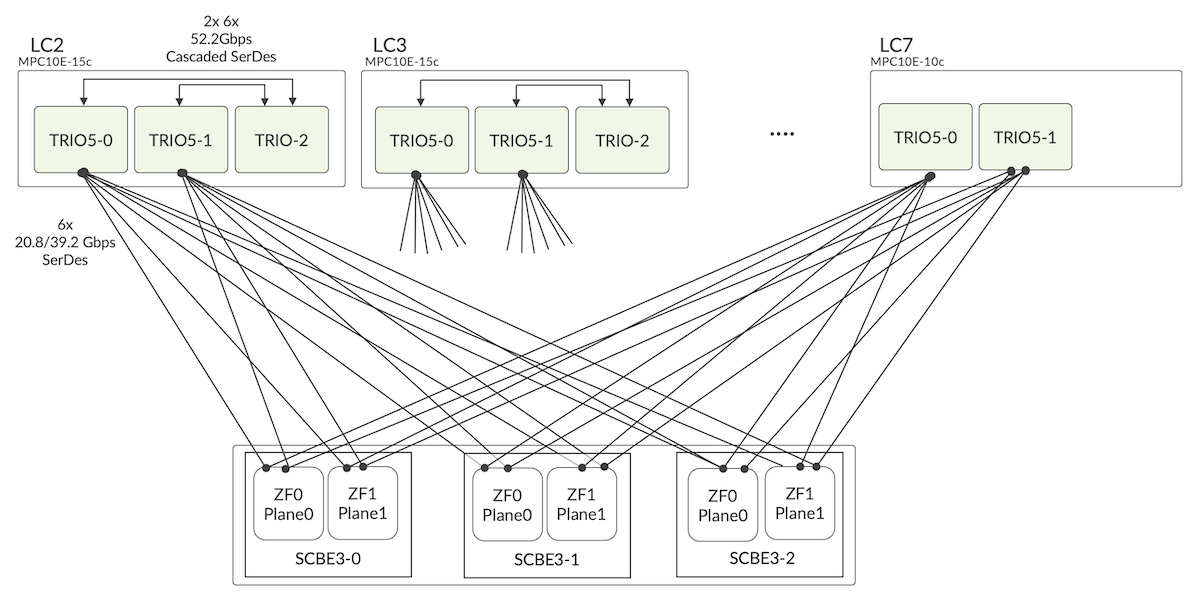
MPC10E-10c has only two Trio5s, so the fabric cascade SerDes lanes will spray the traffic onto the fabric. This helps in achieving line-rate performance with two fabric cards in the case of MPC10E-10c.
As shown in the MPC10E and SCBE3 interconnect picture. There are a total of 6 planes available in the three fabric cards. All the planes are needed to be active to achieve line rate performance in a system with enhanced midplane for MPC10E-15c. For systems with legacy midplanes, the throughput performance will reduce. Here is table summarizing all these details.
| MX960 Redundancy | Throughput -- MPC10E-15c | Throughput -- MPC10E-15c |
|---|---|---|
| 3+0 | 1.5T | 1T |
| 2+1 | 1T | 1T |
There is one important consideration that has to be taken care of while installing an MPC10E line card. Due to cooling and power requirements, MX960 cannot have MPC10E in slots 0, 1 and 11. In a DC environment or at 25C, all the remaining slots of MX960 can have both variants of MPC10E. There are no such restrictions on MX480 and MX240.
Here is a table with the number of MPC10E supported under different environmental conditions.
| Hardware SKU | Temperature | MX960 | MX480 | MX240 |
|---|---|---|---|---|
| MPC10E-10C | 25C | 8 slotsSlots 0, 1, 11: N/A | 6 slots | 2 slots |
| 40C | 8 slotsSlots 0, 1, 11: N/A | 6 slots | 2 slots | |
| 55C | 8 slotsSlots 0, 1, 11: N/A | 6 slots | 2 slots | |
| MPC10E-15C | 25C | 8 slotsSlots 0, 1, 11: N/A | 5 slots | 2 slots |
| 40C | 7 slotsSlots 0, 1, 11: N/A | 4 slots | 2 slots | |
| 55C | Not Supported | Not Supported | Not Supported |
The above output shows different generations of MPCs successfully operating in an MX960 chassis along with the required common components.
References
- MX960/480/240 Hardware Guide
https://www.juniper.net/documentation/us/en/hardware/mx960/mx960.pdf https://www.juniper.net/documentation/us/en/hardware/mx480/mx480.pdf https://www.juniper.net/documentation/us/en/hardware/mx240/mx240.pdf
Glossary
- FIB: Forwarding Information Base
- HBM: High Bandwidth Memory
- LCPU: Line Card CPU
- LUSS: Lookup Sub-System
- MCIF: Memory Control Interface
- MPC: Modular Port Concentrator
- MQSS: Memory and Queuing Sub-System:
- NRZ: Non-Return to Zero
- OCPMem: On-Chip Memory
- PCB: Printed Circuit Board
- PFE: Packet Forwarding Engine
- PIC: Physical Interface Cards
- PMB: Processor Mezzanine Board
- PPE: Packet Processing Engines
- QSFP-DD: Quad Small Form Factor Pluggable Double Density
- SerDes: Serializer/Deserializer
- SRAM: Static Random Access Memory
- SCBE3: Switch Control Board Card (gen3)
- XQSS: Extended Queuing Sub-System
- ZF: Chipset used in SFB Switch Fabric Cards
Acknowledgement
I want to express my gratitude to my mentor Nicolas Fevrier, Sr. Director, PLM, for the detailed reviews of the blog. I would also like to thank Eswaran Srinivasan, Distinguished Engineer and Vasily Mukhin for providing their valuable input.