Secure BGP with ASPA: Preventing and fixing route leaks
Anton Elita - 07/13/2026
BGP runs on trust, and route leaks and hijacks are what happen when that trust is misplaced. This article shows how three complementary mechanisms close the gap - BGP Roles with Only-To-Customer attribute prevent and detect leaks several hops from the source, and - if the leak already happened - RPKI Route Origin Authorization (ROA) helps validate the origin AS, and Autonomous System Provider Authorization (ASPA) confirms the full AS PATH is valley-free.
Any BGP speaker can advertise a syntactically valid route for almost any prefix. Commercial relationships between autonomous systems, such as customer, provider, and peer, are supposed to constrain BGP prefix advertisements. When those relationships are violated - by mistake or by intent - the result is a route leak or hijack, and many related outages have been observed on the Internet. RFC7908 provides a taxonomy and classification of route leaks based on these relationships. This article examines the three complementary mechanisms that allow enforcing business relationships into routing policies.
Three mechanisms defined at IETF are converging to enforce the relation policies and avoid leaks
Route Origin Authorization (ROA) [RFC9582]: a signed object that helps validate the origin AS of a prefix
BGP Roles [RFC9234]: prevents route leaks from happening
Autonomous System Provider Authorization (ASPA) [draft]: signed object, helps validate the whole AS path is valley-free, thus aiding in the detection of a critical case where prefixes with possibly valid origin, but being advertised over an illegitimate AS path.
Note: ASPA validation in Junos is a planned feature for a later release. The CLI examples below are based on unreleased Junos code. *
Beyond the protocol mechanics, we cover the combined ROA + ASPA decision logic, examples of Junos import policies, CLI, and observability. The takeaway: these three-layered mechanisms turn "we trust BGP speakers on the internet behaved" into "we can verify they did."
Operators already mitigate leaks with per-neighbor prefix lists (often IRR-derived, sometimes inconsistent, and sources are somewhat random), RPKI route origin validation, AS_PATH filtering such as peer-lock, max-prefix limits, and community-based tagging of customer/peer/uplink routes. These work, but are maintenance-heavy and depend on operator discipline. Solutions from the IETF stack below make the policy itself verifiable.
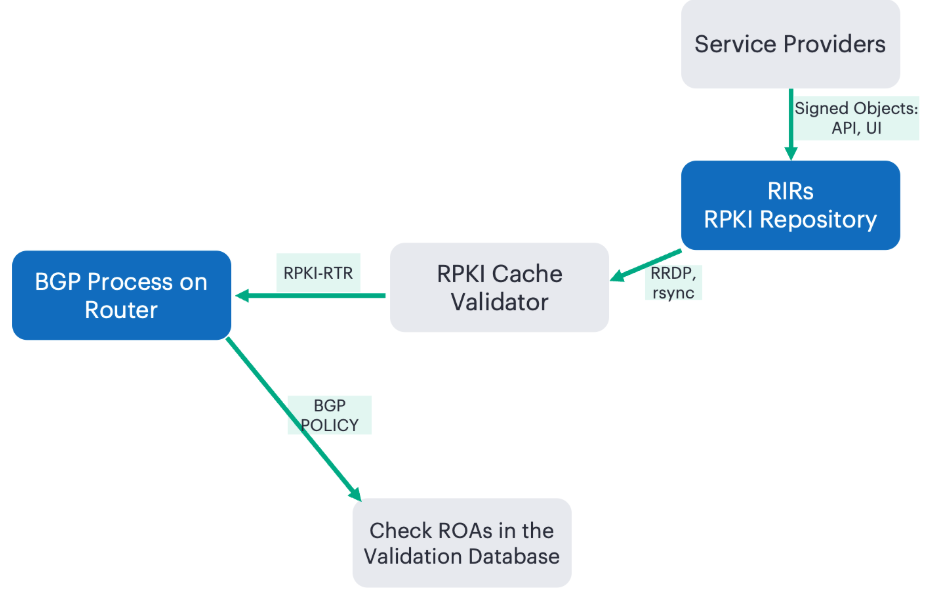
Since 2012, Junos has supported RPKI route origin validation. This process can be summarized as follows:
Network operators create cryptographically signed objects within RPKI repositories that prove the origin AS for a prefix
Users of RPKI ROA can run RPKI cache validators to download the verified ROA objects via RRDP or rsync
Routers use the RPKI-RTR protocol to download the data from cache validators
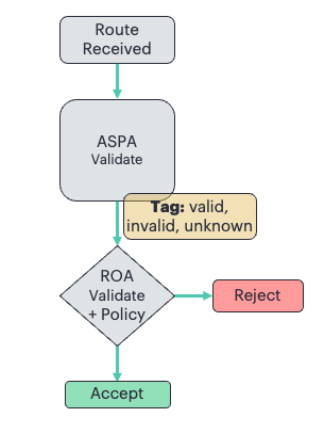
Every prefix can be evaluated in the BGP ingress policy for validity: valid, invalid, or NotFound.
Finally, the policy may specify an action to be taken based on the validation result: accept, reject, modify the preference, attach community, among others.
Figure 1: ROA Validation
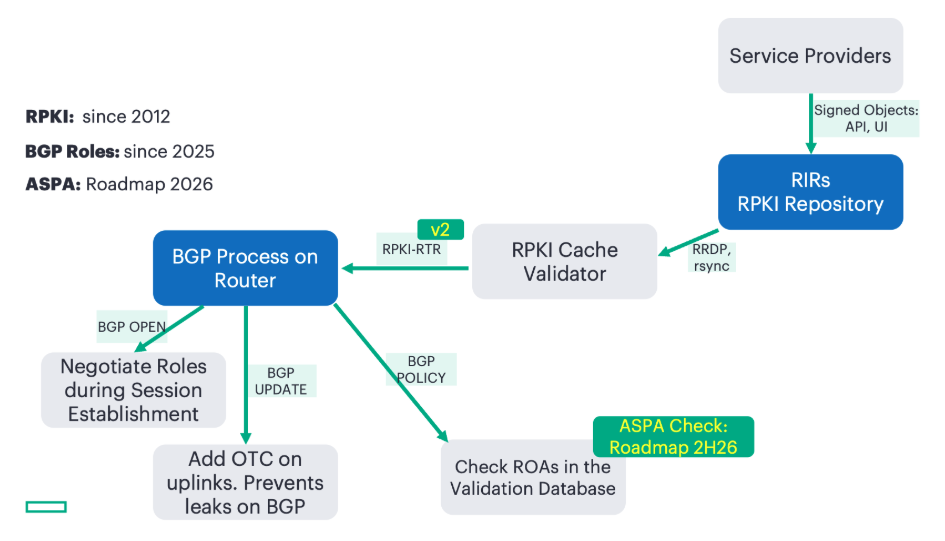
For AS Path validation using ASPA records, the above procedure is extended as follows:
Network operators can add their providers to the RPKI repository
Routers can fetch ASPA records as specified by the RPKI-RTR v2 protocol
Policies can be enhanced to validate both ASPA and ROA
Together with BGP roles, the process of preventing and fixing route leaks would look like this:
Figure 2: BGP Roles, ROA, and ASPA: in one picture
Let us go deeper into the details of this architecture.
Reference Topology and Business Relations between Network Operators
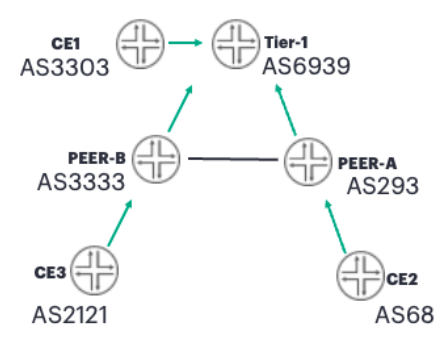
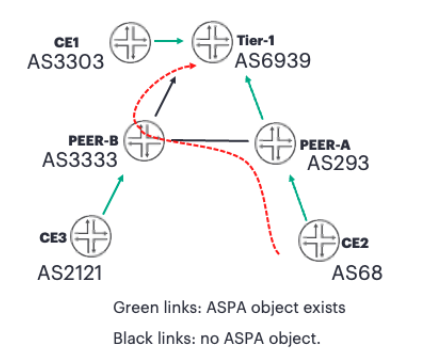
Below is a small topology of three "leaf" customers (CE1, CE2, CE3), two mid-size transit AS (PEER-A and PEER-B, they peer with each other) and one transit-free AS labeled as Tier-1.
Figure 3: Reference Topology
The business relations between all of them can be described in this table:
Business Relations
AS 68 is a customer of AS 293
AS 293 is a customer of AS 6939
AS 2121 is a customer of AS 3333
AS 3303 is a customer of AS 6939
AS 3333 is a customer of AS 6939
AS 3333 may be a peer of AS 293
Table 1: Business relations between Autonomous Systems
Let's consider a prefix 130.55.0.0/16 originated by AS 68, and propagated to AS 293. From the perspective of the "Tier-1" node, this prefix may arrive only from the "Peer-A" node (AS_PATH 68 293), but not from the "Peer-B" (AS_PATH 3333 293 68) -- because AS 3333 is allowed to send prefixes received from a peer only downstream to its customers, but not upstream or laterally to other peers.
Route Origin Validation alone would show the prefix as valid:
set protocols bgp group X neighbor Y otc-local-role [ customer | peer | provider ] [ strict ]
The keyword strict should be used when we don't want a BGP session to come up if the remote speaker is not trying to negotiate this capability. Without strict, a session would come up, and the behavior regarding the OTC attribute and AS_PATH validation would be the same as if the role had been negotiated.
As the next step, let us configure all BGP roles as per the "business relations" table above. There is only a single "peer" neighborship; all others are "customer-provider".
After properly setting the roles, the BGP session is expected to bounce once and come up with the proper roles.
The role (Type 9) is carried in the *BGP OPEN *capability set and negotiated at session establishment.
Jun 11 14:33:56 tier-1 rpd[18844]: bgp_process_role_cap:201: NOTIFICATION sent to 11.3.4.2 (External AS 3333): code 2 (Open Message Error) subcode 11 (role mismatch)
An OTC attribute on the wire is set only when a prefix is advertised to a customer or peer, and must not be overwritten by other BGP speakers. An example for Peer-B sending a prefix towards Peer-A:
Once the OTC attribute was set, a BGP speaker -- even if located multiple hops away - can detect a leak. In this case, "Peer-A" was on purpose configured to improperly announce a prefix from "Peer-B" towards "Tier-1", where the leak was recognized and stopped:
aelita@tier-1# run show bgp diagnostics route 193.0.24.0/21 from 11.3.5.2 table inet.0
Table: inet.0
Route: 193.0.24.0/21 (0x1bf45a20)
State: Hidden Ext Changed
Reason: Route leak detected
Suggestion: Follow these steps to figure out why route leak is detected
  1. Use "show route hidden extensive" to find attribute Only-to-customer > 0
  2. Use "show bgp neighbor" to find Peer role
  3. If a route with the OTC Attribute is received from a Customer or
     an RS-Client, then it is a route leak and MUST be considered ineligible
     If a route with the OTC Attribute is received from a Peer (i.e.,
     remote AS with a Peer Role) and the Attribute has a value that is
     not equal to the remote (i.e., Peer's) AS number, then it is a
     route leak and MUST be considered ineligible.
We will not dive further into the implementation of BGP roles to keep this article shorter. A link to more details is available in the References section.
While it takes time until most BGP speakers on the Internet negotiate their roles, let's investigate how ASPA can help in the meantime. At this step, we removed the BGP roles from the configurations.
RPKI infrastructure has been built to act as a source of truth for:
which AS is entitled to be the origin of a prefix - ROA
inter-AS relations (customer/provider) - ASPA
and can be characterized by the following:
Cryptographic certificates protect the data
well-defined transports for downloading the databases: RRDP, rsync
trusted organizations that store the signed data: RIRs/LIRs like RIPE, ARIN, APNIC, LACNIC
Route Origin Validation has been known for quite a while, so please check the References below for more details. We'll concentrate on ASPA instead. ASPA describes BGP relations between players on the Internet. Only "customers" are needed to publish their "providers":
peers need not be registered
single RPKI ASPA object for one AS: all providers are listed as a set of AS numbers.
The table describing business relations can be "translated" into ASPA objects. We've taken the most recent RPKI database at the time of writing. Only AS numbers relevant to our topology have been considered.
ASPABusiness Relations
ASPA Objects
Customer
AS 68 is a customer of AS 293
68
AS 293 is a customer of AS 6939
293
AS 2121 is a customer of AS 3333
2121
AS 3303 is a customer of AS 6939
3303
AS 3333 is a customer of AS 6939
3333
AS 3333 may be a peer of AS 293
-
AS 6939 is Tier-1 - no upstream
6939
Table 2: Business Relations represented as ASPA objects
Note: if an AS has no upstream -- example being a tier-1 ISP, or an IXP network -- they can register AS0 as their "provider" ASPA object: *
aelita@tier-1# run show validation database aspa-record 3257
RV database: default
Customer-AS       Provider-AS   Session
3257              0             11.254.254.61
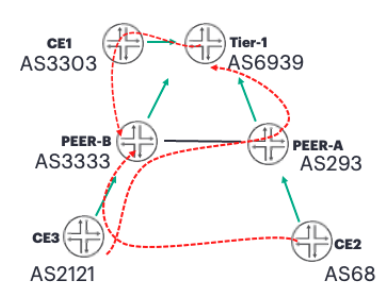
The use of AS0 is defined in RFC 7607. The validation process with ASPA makes sure that an AS_PATH is valley-free. A valley occurs when a BGP speaker propagates a prefix received from a non-customer (i.e., an upstream or peer) to another non-customer.
Figure 4: Examples of Valleys
With both Route Origin and ASPA validation, there are several ways to build an import policy. If we want to reject a prefix if either ROA or ASPA is invalid:
set policy-options policy-statement RV term invalid from validation-database invalid
set policy-options policy-statement RV term invalid then validation-state invalid
set policy-options policy-statement RV term invalid then reject
set policy-options policy-statement RV term aspa-invalid from validation-database aspa-invalid
set policy-options policy-statement RV term aspa-invalid then validation-state invalid
set policy-options policy-statement RV term aspa-invalid then reject
set policy-options policy-statement RV term unknown from validation-database unknown
set policy-options policy-statement RV term unknown then validation-state unknown
set policy-options policy-statement RV term unknown then accept
set policy-options policy-statement RV term aspa-unknown from validation-database aspa-unknown
set policy-options policy-statement RV term aspa-unknown then validation-state unknown
set policy-options policy-statement RV term aspa-unknown then accept
set policy-options policy-statement RV term valid then validation-state valid
set policy-options policy-statement RV term valid then accept
If we want to implement a more sophisticated policy, where any combination of ROA and ASPA can be matched, and a desired validation result and action can be chosen, like in the table below:
ROA
ASPA
Validation Result
Example Action
valid
valid
valid
accept
valid
invalid
invalid
reject(strict),oraccept + lower preference(loose)
valid
unknown
valid
accept
invalid
*
invalid
reject
unknown
*
unknown
accept
Table 3: Validation result and action
Such a workflow in an import policy can be represented by this figure:
Figure 5: Validating ROA and ASPA on BGP import
Please note, this is an example policy, and Junos allows other combinations of matches and resulting actions.
In this example workflow, Junos can first validate ASPA and tag a prefix based on the validation result. Then, it can validate the origin and take a decision based on the combined ROA and ASPA validation results.
A policy chain can be assigned from two import policies: the first validates ASPA and passes to the second policy, which then checks the ROA and defines the action and validation state.
set protocols bgp group tier1-peerb import [ aspa-validate rpki-validate-strict-aspa ]

set policy-options policy-statement aspa-validate term unknown from validation-database aspa-unknown
set policy-options policy-statement aspa-validate term unknown then tag 64
set policy-options policy-statement aspa-validate term unknown then next policy
set policy-options policy-statement aspa-validate term valid from validation-database aspa-valid
set policy-options policy-statement aspa-validate term valid then tag 65
set policy-options policy-statement aspa-validate term valid then next policy
set policy-options policy-statement aspa-validate term invalid from validation-database aspa-invalid
set policy-options policy-statement aspa-validate term invalid then tag 66
set policy-options policy-statement aspa-validate term invalid then next policy
set policy-options policy-statement aspa-validate term Z then next policy

set policy-options policy-statement rpki-validate-strict-aspa term roa-valid-aspa-valid from protocol bgp
set policy-options policy-statement rpki-validate-strict-aspa term roa-valid-aspa-valid from validation-database valid
set policy-options policy-statement rpki-validate-strict-aspa term roa-valid-aspa-valid from tag 65
set policy-options policy-statement rpki-validate-strict-aspa term roa-valid-aspa-valid then validation-state valid
set policy-options policy-statement rpki-validate-strict-aspa term roa-valid-aspa-valid then accept
set policy-options policy-statement rpki-validate-strict-aspa term roa-valid-aspa-unknown from protocol bgp
set policy-options policy-statement rpki-validate-strict-aspa term roa-valid-aspa-unknown from validation-database valid
set policy-options policy-statement rpki-validate-strict-aspa term roa-valid-aspa-unknown from tag 64
set policy-options policy-statement rpki-validate-strict-aspa term roa-valid-aspa-unknown then validation-state valid
set policy-options policy-statement rpki-validate-strict-aspa term roa-valid-aspa-unknown then accept
set policy-options policy-statement rpki-validate-strict-aspa term roa-valid-aspa-invalid from protocol bgp
set policy-options policy-statement rpki-validate-strict-aspa term roa-valid-aspa-invalid from validation-database valid
set policy-options policy-statement rpki-validate-strict-aspa term roa-valid-aspa-invalid from tag 66
set policy-options policy-statement rpki-validate-strict-aspa term roa-valid-aspa-invalid then validation-state invalid
set policy-options policy-statement rpki-validate-strict-aspa term roa-valid-aspa-invalid then reject
set policy-options policy-statement rpki-validate-strict-aspa term roa-invalid-aspa-any from protocol bgp
set policy-options policy-statement rpki-validate-strict-aspa term roa-invalid-aspa-any from validation-database invalid
set policy-options policy-statement rpki-validate-strict-aspa term roa-invalid-aspa-any then reject
set policy-options policy-statement rpki-validate-strict-aspa term roa-unknown-aspa-any from protocol bgp
set policy-options policy-statement rpki-validate-strict-aspa term roa-unknown-aspa-any from validation-database unknown
set policy-options policy-statement rpki-validate-strict-aspa term roa-unknown-aspa-any then validation-state unknown
set policy-options policy-statement rpki-validate-strict-aspa term roa-unknown-aspa-any then accept
Examples of ASPA Validation:
With the policies above, let's see if the following leak can be detected:
Figure 6: Leaking from AS3333 to an upstream
"Tier-1" is the validating node. Without BGP roles configured anywhere, and with missing ASPA objects for both AS6939 and AS3333, ASPA validation cannot detect a leak, just because AS3333 might theoretically also be a provider of AS6939...
aelita@tier-1# set protocols bgp group tier1-peerb neighbor 11.3.4.2 otc-local-role provider
aelita@tier-1# commit

aelita@tier-1# run show route 130.55.0.0/16 detail next-hop 11.3.4.2 hidden
130.55.0.0/16 (2 entries, 1 announced)
         BGP                 /-101
                Next hop type: Router, Next hop index: 623
                Address: 0x99c4890
                Next-hop reference count: 3, Next-hop session id: 320
                Kernel Table Id: 0
                Source: 11.3.4.2
                Next hop: 11.3.4.2 via ge-0/0/3.0, selected
                Session Id: 320
                State: <Hidden Ext Changed>
                Inactive reason: Unusable path
                Local AS:  6939 Peer AS:  3333
                Age: 18
                Validation State: invalid
                        Tag: 66
                Task: BGP_3333.11.3.4.2
                AS path: 3333 293 68 I
                Localpref: 100
                Router ID: 11.3.4.2
                Hidden reason: Rejected by import policy
The leak was stopped because "Tier-1" now has the missing piece of the puzzle: when both AS3333 and AS293 are customers of AS6939, then the AS_PATH above is a valley, i.e., a prefix leak.
aelita@pe2# run show validation session
Session            Version   State   Flaps     Uptime    #IPv4/IPv6 records    ASPA records
11.254.254.61            2.   Up         0   1d 04:30:49 687395/216202         2033
Version of RPKI-RTR protocol now includes support for RFC8210bis, which introduced ASPA data retrieval.
I would like to thank Santosh Kolenchery and the entire BGP software engineering team for making these features a reality, and for reviewing this techpost.