SR Tactical Traffic Engineering in Junos
Junos OS 23.4R1 introduces Segment Routing Tactical Traffic Engineering (SR-TTE), a unique and innovative solution designed to address temporary network congestion by dynamically adjusting traffic flows in real-time, directly within the router. SR-TTE leverages existing mechanisms to alleviate congestion without requiring interoperability between different router vendors or with external controllers.
Overview
Tactical Traffic Engineering (TTE) is designed to solve temporary congestion problems, such as those occurring due to unexpected heavy traffic loads. Unlike conventional traffic engineering, which proactively places tunnels to avoid congestion, TTE is a reactive solution that adjusts traffic flows in response to local congestion. This eliminates dependencies on external controllers and concerns about interoperability.
One of the key advantages of SR-TTE is its simplicity. It does not add additional labels or overhead to existing packets, nor does it manipulate the original user-plane data. Instead, TTE leverages the existing source of truth - the information within the router, making it an efficient and straightforward solution.
Segment Routing (SR), although offering many benefits, falls short in its ability to effectively manage bandwidth when compared to RSVP auto-bandwidth. RSVP auto-bandwidth addresses congestion proactively by dynamically adjusting the bandwidth allocation for LSPs based on real-time ingress traffic measurements, ensuring efficient handling of varying traffic loads. However, Segment Routing (SR) lacks this capability. SR is also dependent on external controllers for traffic (bandwidth) management. To address this limitation, TTE compliments SR by providing a mechanism to manage traffic dynamically and alleviate congestion directly on the router, without relying on an external controller, by reusing SR's TI-LFA backup routes for redirecting flows.
TTE responds to congestion in real-time by detecting data-plane traffic congestion and adjusting traffic flows accordingly. Once the congestion is abated, the network returns to its normal operation by moving flows back to their 'normal' paths.
The primary capability of TTE is its ability to handle traffic congestion by utilizing alternative paths and avoiding unnecessary packet loss. This is achieved without the need to export large amounts of data to an external controller for analysis and subsequent adjustment via NETCONF or PCEP.
Syntax
Pre-requisites: Enable TI-LFA
Enable congestion protection and ISIS as a client
Additional options
Related show commands
Congestion Scenario 1: An Ingress Router (PE)
In the scenario below, depicted in Figure 1, PE1's uplink to PE2 experiences high traffic loads of more than 80% utilization. This could lead to congestion, causing packet loss, increased latency, and overall degraded network performance. TTE is enabled for this interface and continuously monitors its transmit load. The congestion protection policy is triggered when utilization exceeds the configured value of 80% for several (default = 3) consecutive (default = 5 sec intervals) statistic samples.
When the congestion protection policy is triggered, TTE randomly selects 'some' flows for load-balancing via available backup paths to alleviate the congestion. Instead of sending all the traffic to PE2, TTE activated flows are load-balanced between the primary path to PE2 and the TI-LFA backup path via PE3, then to P4, and finally to PE6 and PE7.
TTE flow selection can be controlled using policy. This allows the operator to control which services may be subject to load-balancing via TI-LFA backup routes.
Once TTE has been activated, the router continuously monitors the aggregate utilization of both the primary outgoing interface and the load moved to the backup paths. Once the traffic load falls below the low threshold (e.g., 50%) for several (default = 3) consecutive (default = 5 sec intervals) statistic samples, TTE selected prefixes are deactivated, and all flows return to their primary path directly to PE2. This dynamic approach ensures real-time congestion management, optimized network performance, and reduced dependency on external controllers.
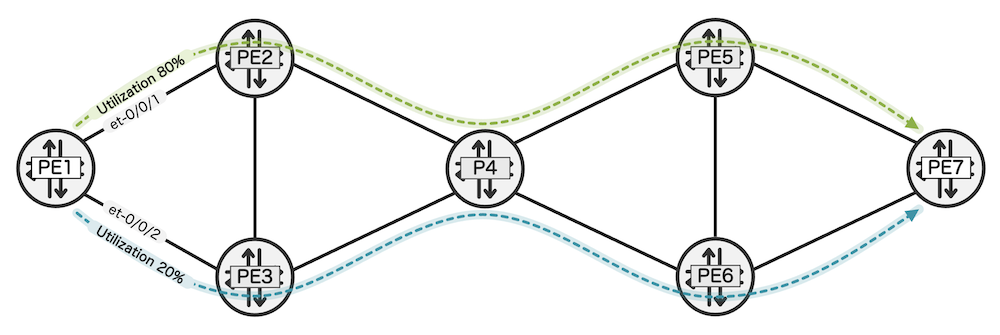
The green and blue lines above illustrate the possible traffic flow.
PE1 Configuration
TTE active on PE1
Congestion Scenario 2: A Transit Router (LSR)
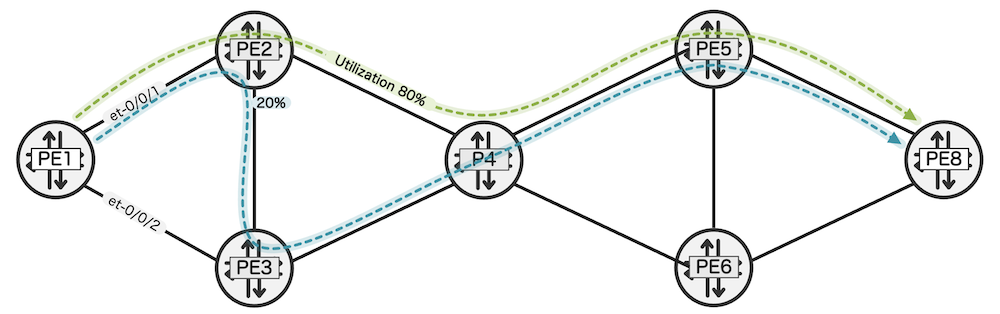
In the scenario depicted in Figure 2, the SR transit router PE2 uplink to P4 experiences high traffic loads of greater than 80% utilization, exceeding the configured congestion protection high threshold policy. As before, when the congestion protection policy is triggered, TTE randomly selects 'some' flows for load-balancing via available backup paths to alleviate the congestion. And when congestion has abated, the use of the additional backup paths is disabled.
Conclusion
TTE provides a simple, fast, and efficient mechanism to react to potential congestion by leveraging existing technology. Because it does not rely on additional protocols or external controllers it can be incrementally deployed in targeted areas of a network without interoperability concerns.
Glossary
- IGP: Interior Gateway Protocol
- IS-IS" Intermediate System to Intermediate System
- LSP" Label Switched Path
- NETCONF" Network Configuration Protocol
- PCEP: Path Computation Element Protocol
- PE: Provider Edge
- PFE: Packet Forwarding Engine
- RSVP: Resource Reservation Protocol
- SID: Segment Identifiers
- SR: Segment Routing
- TI-LFA: Topology Independent Loop-Free Alternate
- TTE: Tactical Traffic Engineering
Useful links
- Tactical Traffic Engineering: https://datatracker.ietf.org/doc/draft-li-rtgwg-tte/
- MPLS Auto-bandwidth: https://www.juniper.net/documentation/us/en/software/junos/mpls/topics/topic-map/basic-lsp-configurtion.html#id-automatic-bandwidth-allocation-for-lsps
Acknowledgments
Thanks to Colby Barth and Tony Li for developing Tactical Traffic Engineering and contributing to this article.