ZR/ZR+ Coherent Optics in ACX7100-32C
How does the Juniper ACX7100-32C router handle a fully loaded 400GE ZR and 100GE ZR4, long reach, high power coherent optics configuration?
Introduction
In this article, I want to talk about long reach, high power coherent optics challenges on 1RU fixed form-factor routers and how Juniper's ACX7100-32C (Cloud Metro ACX platforms) handles these challenges with design choices to optimize the thermals.
To answer the question with data-points "Will ACX7100-32C handle ZR4/ZR optics across all ports (x36) and stay stable under 4.8Tbps of traffic load and ambient and higher temperature?", the article is divided into three sections:
- System design & choices
- Test topology & KPIs
- Reporting of metrics presented via Grafana dashboard
400GE Optics choices and challenges
Metro and Data Center architectures are evolving to accommodate ever-growing traffic and performance-based applications that demand high bandwidth and low latency.
With the appropriate choice of optic cages, Juniper's Cloud Metro ACX7100-32C router supports coherent optical solutions like 400GE ZR/ZR+ and 100GE ZR4 on all ports.
While the new standards of optics substantially increase bandwidth capacity between the Cloud Metro and Data Centers reducing operating costs, footprint, and power consumption; parameters like optical power (influencing the reach and architectural capabilities) and operating temperature (influencing module packaging) becomes critical vis-e-vis heat dissipation in a 1RU fixed port configuration.
Let's double click on the 400GE deployment requirements and associated challenges in the Access, Metro, and Backbone.
- Operators require off-the-shelf optical modules to build and scale their networks quickly and efficiently. Power at ambient and higher temperature is one of the prime decision-making factors, especially with long-reach coherent optics along with optics cage configurations like stacked caging or belly-to-belly.
- High-performance network environments need to cool pluggable optical modules efficiently. High power modules must dissipate this heat effectively to ensure the operational performance of the modules. Prudent module, cage, heat sink and overall system design for optics modules help to optimize thermals.
Deployment Models with 400GE ZR/ZR+
There are a couple of ways the 400GE ZR/ZR+ are deployed based on the application.
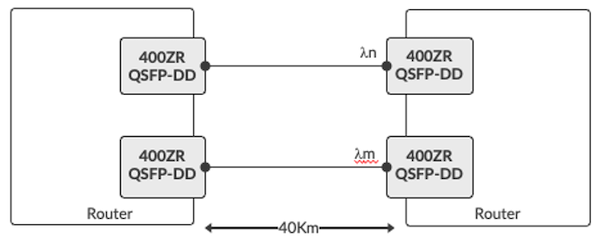
Extended reach P2P packet
In this case, 400GE ZR modules are used as single carrier 400Gbps optical line rate and transporting 400GE, 2x 200GE, or 4x 100GE client signals for point-to-point reach.
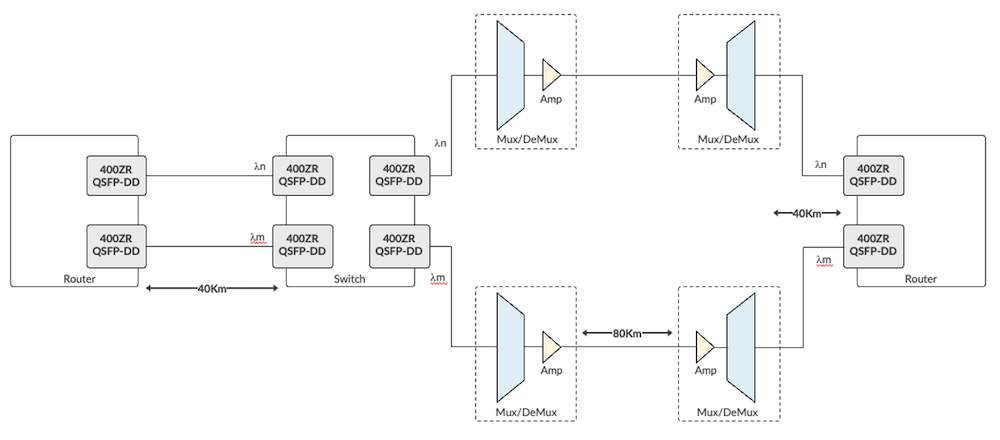
Multi-span Metro
In this case, 400GE ZR provides solutions with higher performance to address a much wider range using amplifiers for metro/regional packet networking requirements.
ACX7100 Series Routers
ACX7100 routers exist in two versions---ACX7100-32C and ACX7100-48L--- and detailed specifications are mentioned in ACX7100 Deepdive (https://juniper.github.io/techposts/acx7100-deepdive/article), here we will focus on the ACX7100-32C router with 400GE ZR and 100GE ZR4 optics.
ACX7100-32C offers:
- Connectivity for 32x 100GE and 4x 400GE (via QSFP-DD connectors)
- Six fan trays, front to back, with 5+1 redundancy
- Two power supply modules (1200W-1600W), with 1+1 redundancy


Juniper's Approach for 400GE ZR/ZR+
Let's double-click on the design consideration and the metrics to highlight the value proposition of the ACX7100-32C router:
- Optics cage and connector layout
- System design to optimize thermals with heat sinks.
The architecture choices of optical cage, connector and its layout have a direct impact on optics' thermal performance. The goal is to exhaust the heat from the module case and ensure the internal components stay within a certain temperature range. It guarantees reliability and optimal performance.
Details on optics design can be found at http://www.qsfp-dd.com/wp-content/uploads/2021/01/2021-QSFP-DD-MSA-Thermal-Whitepaper-Final.pdf
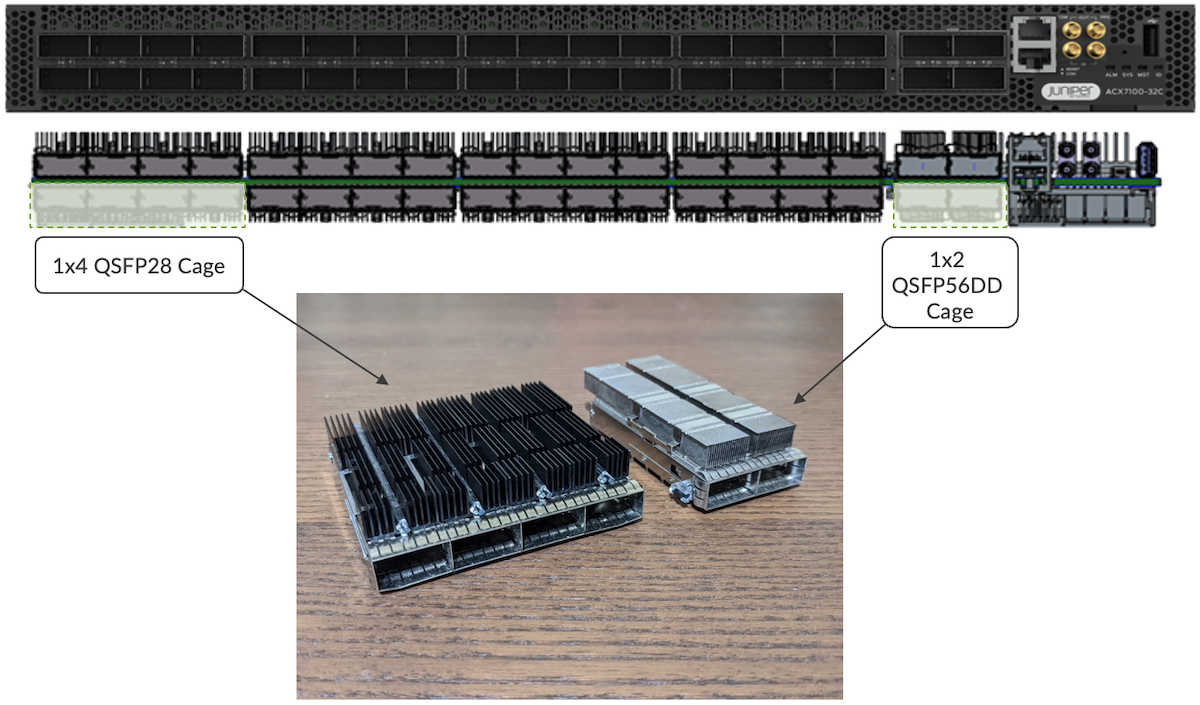
ACX7100-32C router uses QSFP-DD connector for all 32 QSFP28 ports (backward compatible with regular QSFP28 connectors) to accommodate higher power requirements. The system has an optimized design of optics cage for belly-to-belly configuration as show in the figure 4 below:

- 1x4 cages are used for the 32x QSFP28 ports
- 1x2 cages (with the smallest heatsinks) are used for the 4x QSFP-DD ports
The power dissipation ranges of 400GE client and line (ZR, ZR+) optical modules are 10-14W and 16-20W, respectively.
The router is designed for complete voltage range (High Line and Low Line) and supports front-to-back air flow.
| Type | Voltage | Power | Air Flow |
|---|---|---|---|
| AC | 103 to 140V (LL)180 to 264V (HL) | 1200W1600W | AFO |
| DC | -40 to 48V (LL)48 to 72V (HL) | 1200W1600W | AFO |
Thermal & Power Analysis
Completely inhabited ACX7100-32C router with high-power digital coherent optics on all ports, has power rating within 1000 W, at an ambient temperature (25deg C). At higher temperature (55deg C), the power rating increases slightly and is well within 1200 W.
Topology
The router ACX7100-32C is populated with ZR optics connected to the traffic generator. The topology is built with fully meshed traffic (and not with snake) configuration.

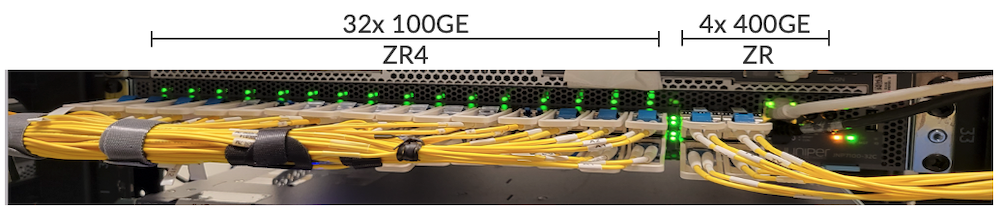
show chassis hardware detail
KPIs to monitor
Power rating: observes the power consumption (typical and maximum) by ACX7100-32C router under ambient and higher temperature. The higher temperature is mimicked by setting the fan speed to maximum.
Power rating are noted at multiple stages:
- Default router configuration without any optics,
- With ZR (-10 dB) optics on all ports and,
- With line rate traffic including random patterns across all ports in a fully meshed configuration.
Router and optics temperature: without and with traffic.
- Ambient temperature of the router
- Temperature of optics (100GE and 400GE) across (x36) ports
We built Grafana dashboards to monitor the KPIs, using REST APIs.
- One dashboard displays power rating of the router, number of optics plugged in, temperature of the optics and ambient temperature of the router
- Another displays attributes of the optics when device is under test.
Note: To reproduce higher temperature conditions, we set up fan speed to maximum with "request chassis fan speed full-speed tray 0"
show chassis fan
Without Optics
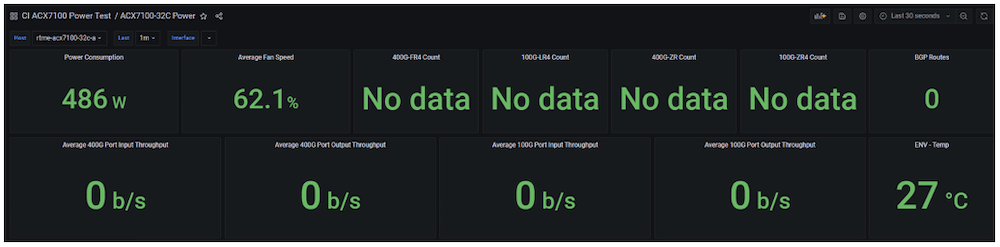
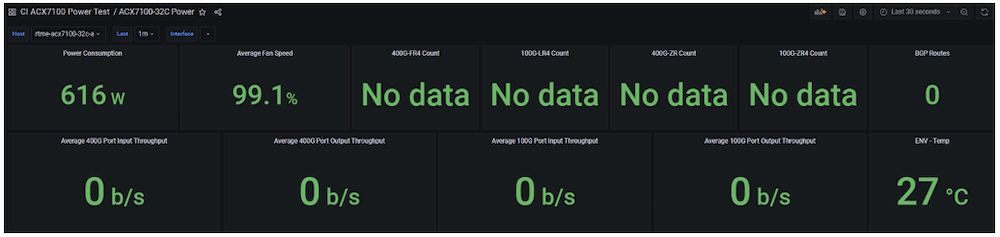
Router power consumption at normal and max fan speed:
| Test Conditions | Environment | Power |
|---|---|---|
| Typical Power (without optics) | Normal Fan Speed | 486W |
| Max Power (without optics) | Maximum Fan Speed | 616W |
ZR optics on all (x36) Ports, no Traffic
Router power consumption and temperature at normal and max fan speed:
| Test Conditions | Environment | Power |
|---|---|---|
| Typical Power with4x 400GE ZR + 32x 100GE ZR4optics plugged-in, no traffic | Normal Fan Speed | 706W |
| Maximum Power with4x 400G ZR + 32x 100GE ZR4optics plugged-in, no traffic | Maximum Fan Speed | 832W |
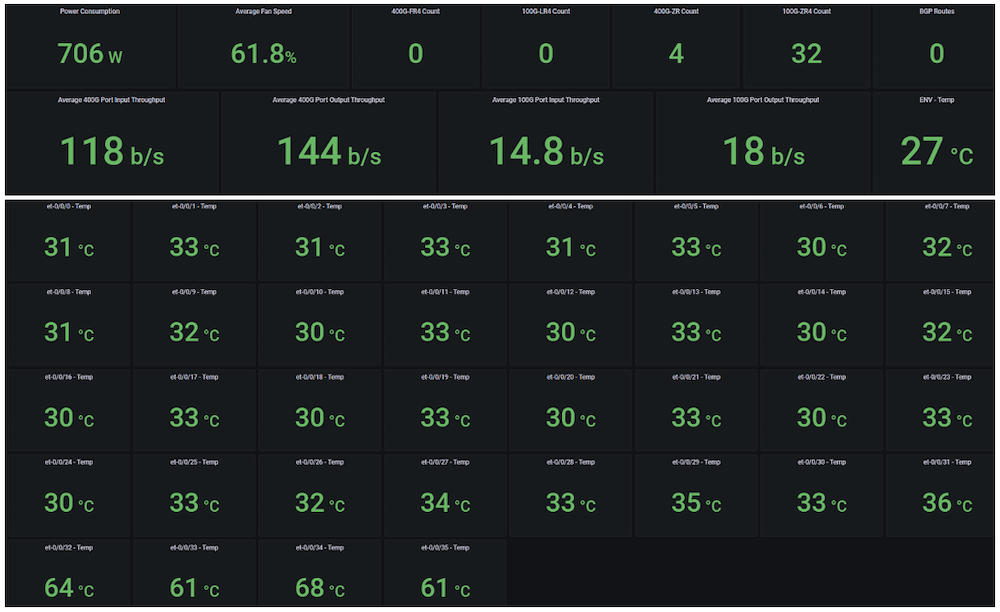
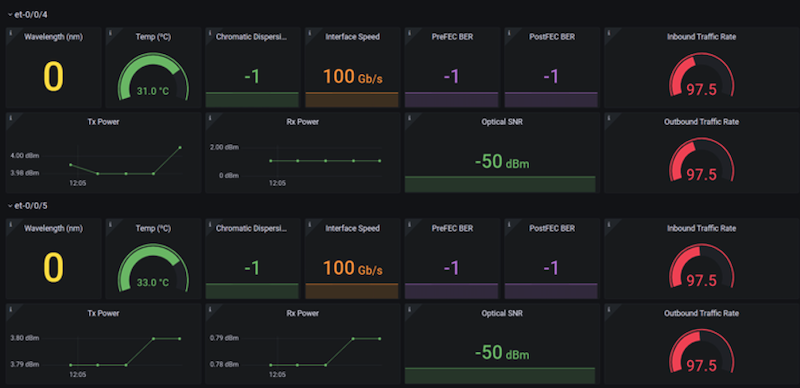
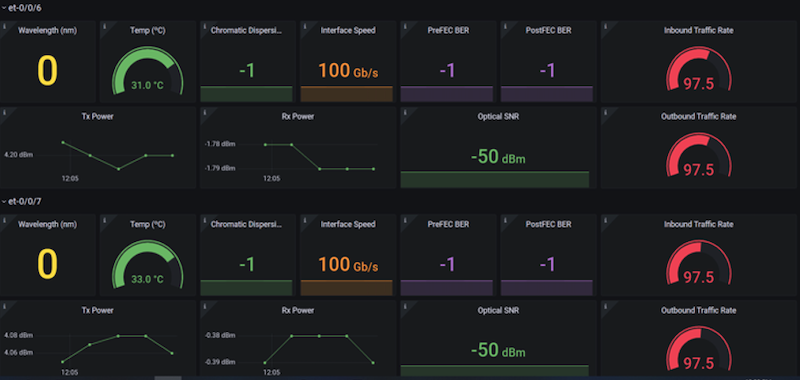
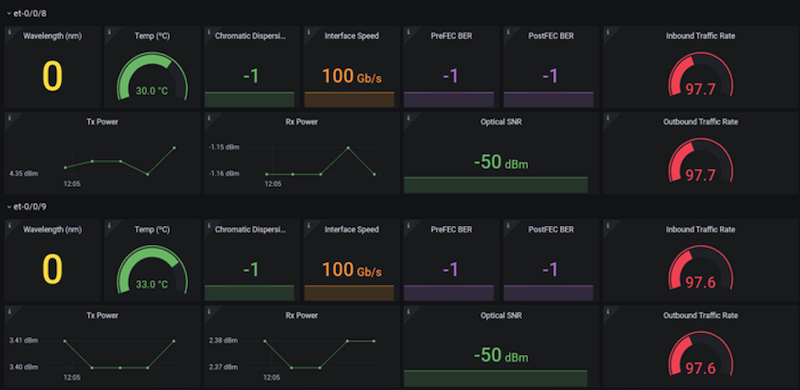
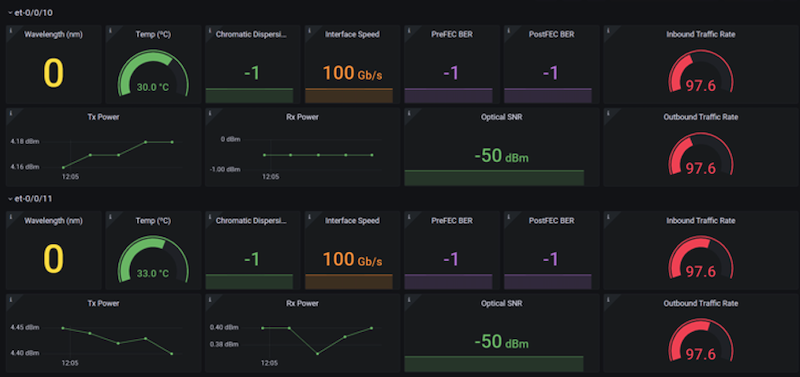
Typical power measured is 706 W by the router at normal fan speed with ZR optics plugged into 4x 400GE and 32x 100GE ports. Temperature of the 100GE optics are in the range of 31-33 degC, while 400GE optics are in the range of 61-68 degC.
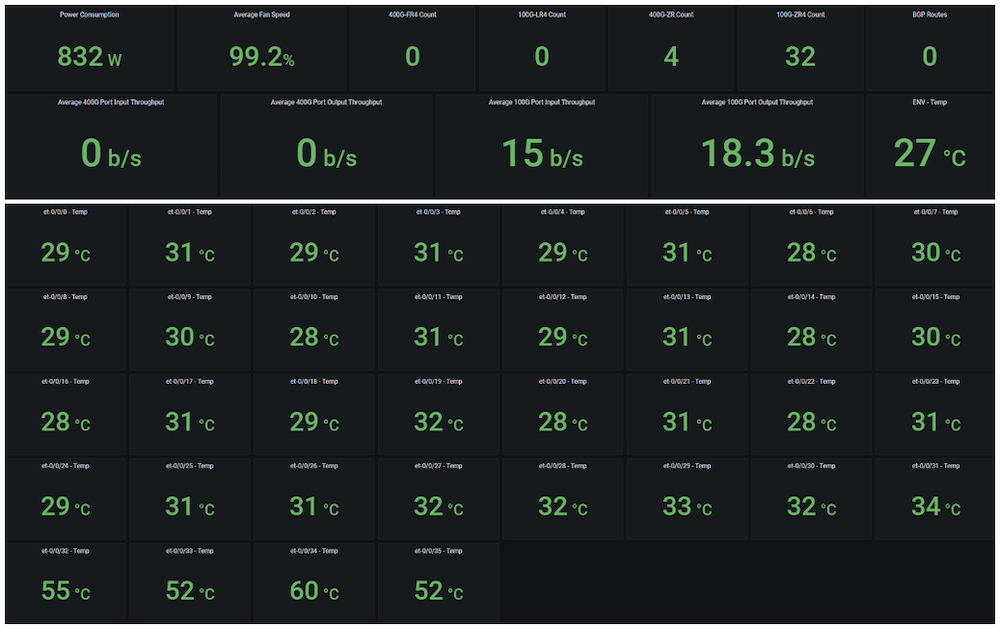
Maximum Power measured is 832 W by the router at maximum fan speed with ZR optics plugged into 4x 400GE and 32x 100GE ports only. Temperature of the 100GE optics are in the range of 28-31 degC, while 400GE optics are in the range of 52-60 degC.
ZR Optics on all (x36) Ports, Full Meshed Line Rate Traffic
Router power consumption and temperature at normal and max fan speed
Traffic profile (IMIX): the traffic generator is configured with fully meshed traffic pattern and following packet sizes, line rate on all ports.
- 64 bytes
- 78 bytes
- 100 bytes
- 373 bytes
- 570 bytes
- 1300 bytes
- 1518 bytes
- 9000 bytes
| Test Conditions | Environment | Power |
|---|---|---|
| Typical Power with4x 400GE ZR + 32x 100GE ZR4optics plugged-in, with traffic | Normal Fan Speed | 791W |
| Maximum Power with4x 400G ZR + 32x 100GE ZR4optics plugged-in, with traffic | Maximum Fan Speed | 920W |
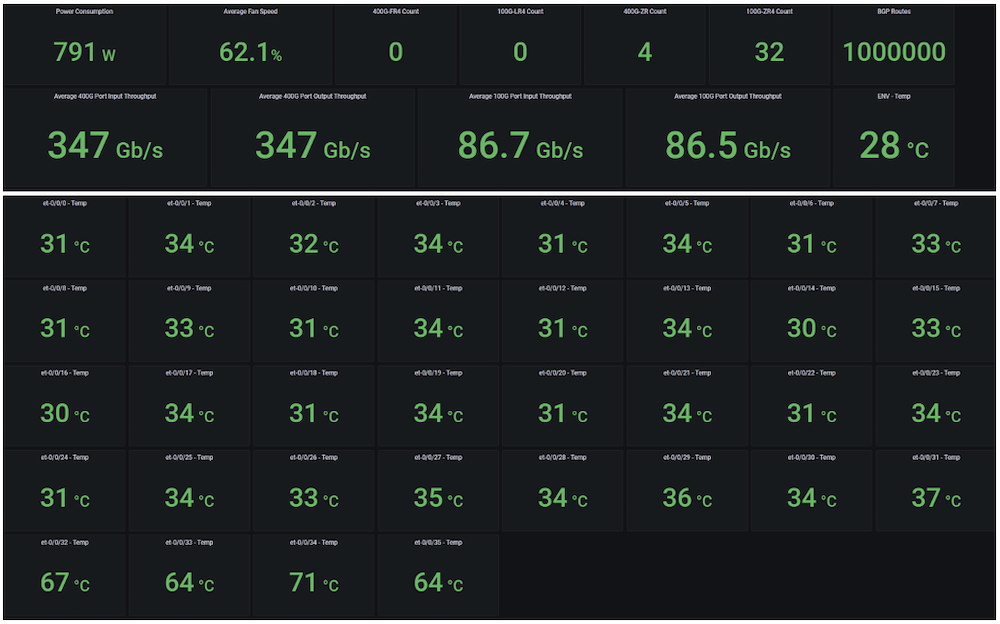
Typical Power measured is 791 W by the router when line rate traffic is sent across 4x 400GE + 32x 100GE ports and fan speed set to normal. Temperature of the 100GE optics is in the range of 31-34 degC, while 400GE optics are in the range of 64-71 degC.
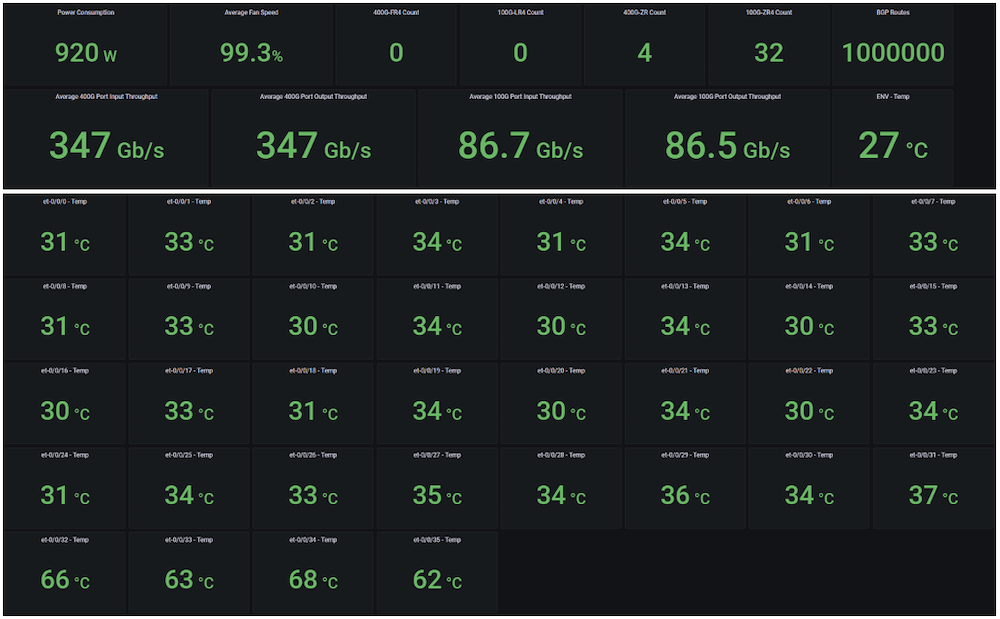
Maximum Power measured is 920 W by the router when line rate traffic is sent across 4x 400GE & 32x 100GE ports and fan speed is set to max. Temperature of the 100GE optics are in the range of 30-37 degC, while 400GE optics are in the range of 62-68 degC.
Summary View
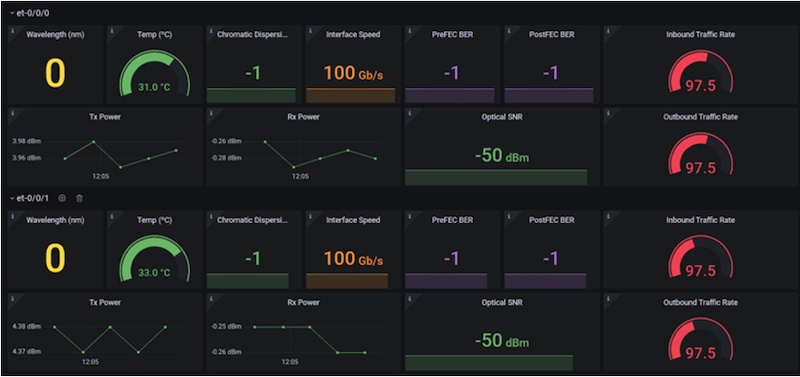
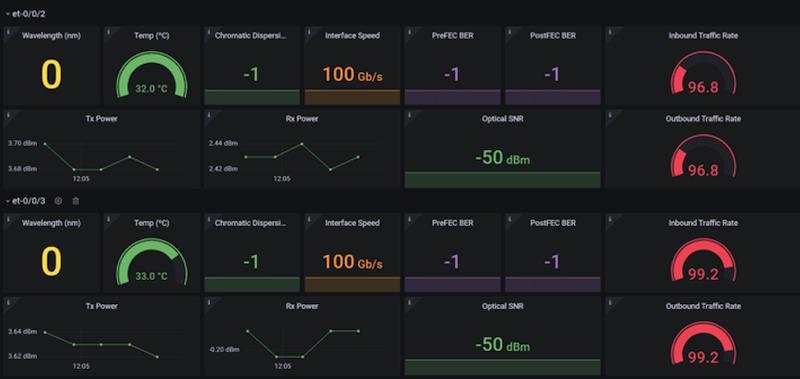
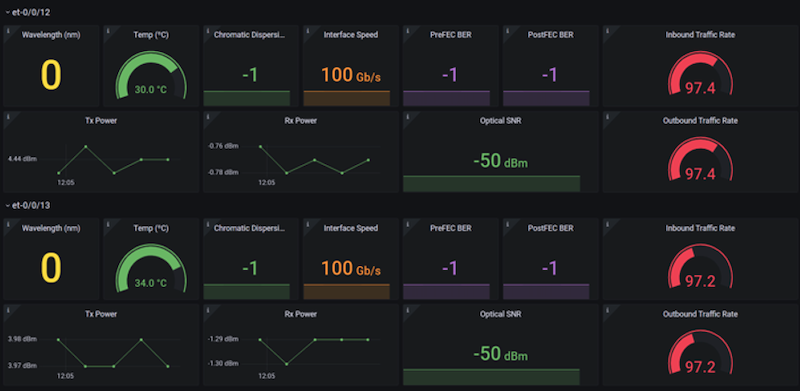
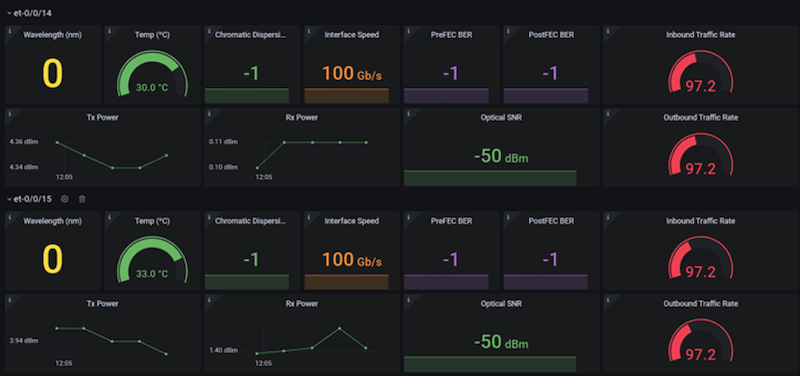
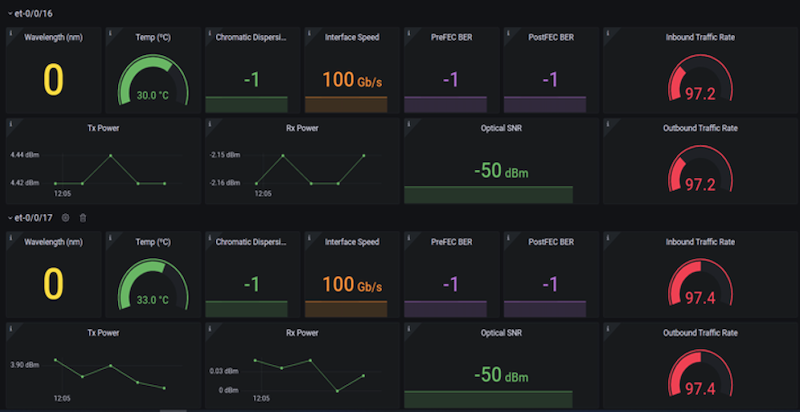
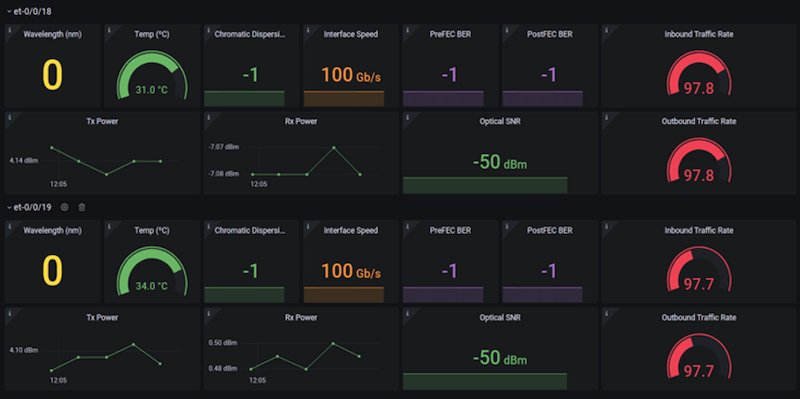
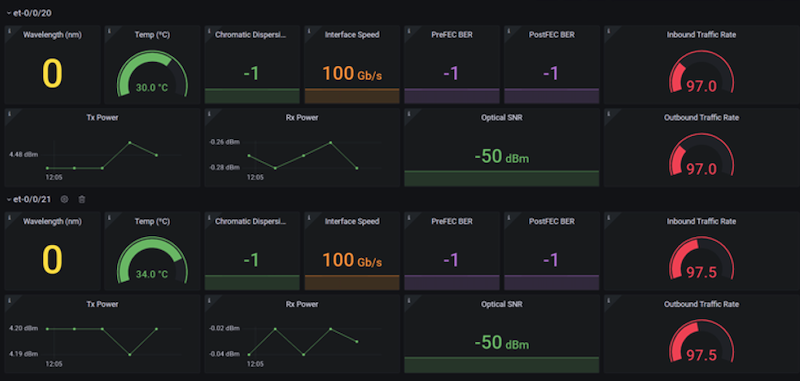
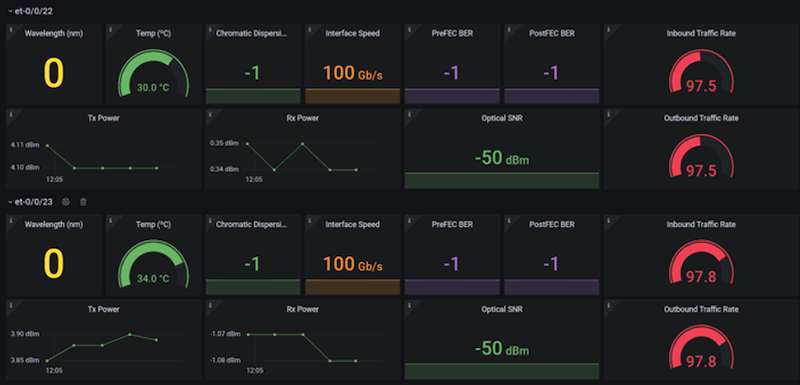
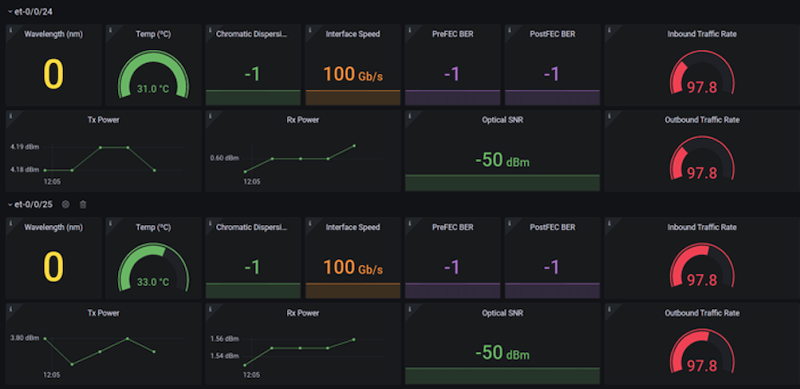
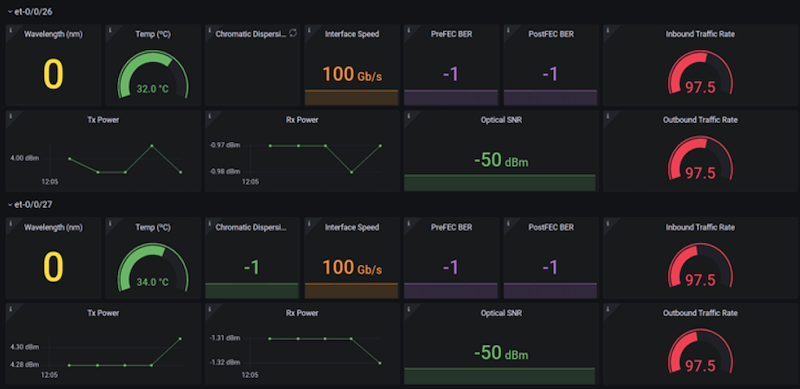
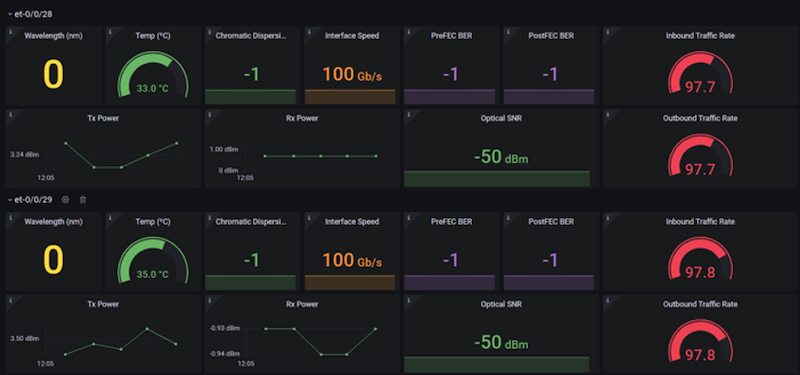
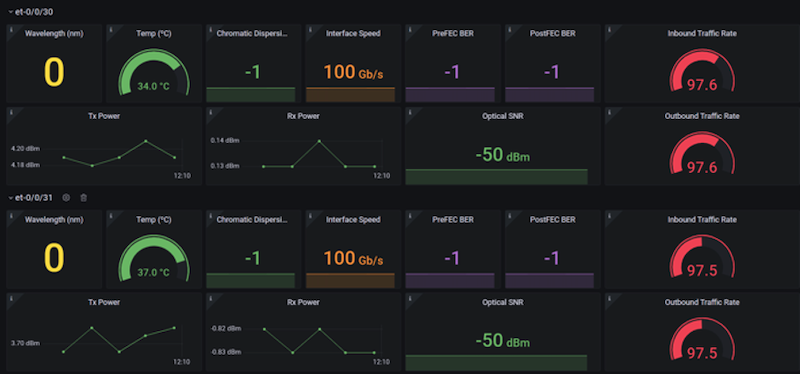
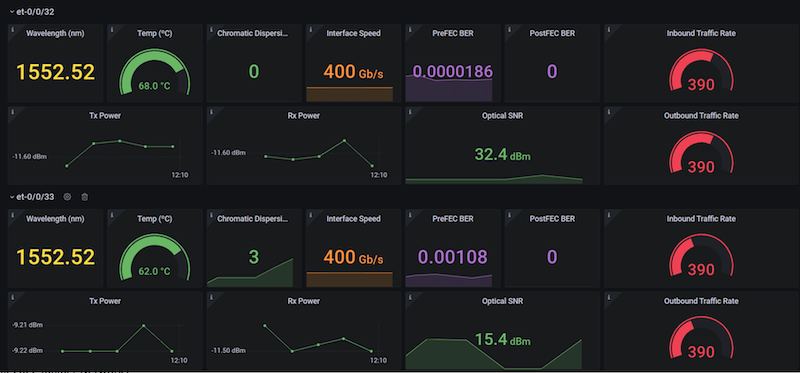
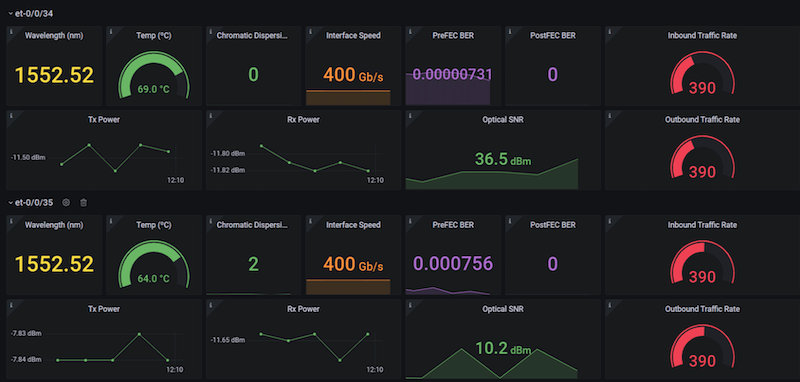
In the following dashboard, we display multiple optic attributes including:
- Chromatic dispersion: arises from the variation in propagation velocity with wavelength
- Optical Signal to Noise Ratio (OSNR): provides a measure of optical noise interference on optical signals. The OSNR values are most critical at the receiving end of the network since if this ratio reduces, then the probability of the receiver recovering the signal is reduced
- Pre-FEC BER: The 400G ZR Optics first transforms the optical signal into a digital bit stream and then applies a forward error correction (FEC), which automatically corrects failed bits, if any. As long as the pre-FEC is below the threshold level, the system ensures that all bit errors are successfully identified and corrected, and therefore, no packet loss occurs
- Input power: If the input power of the optics goes lower than the desired value, indicates that there could be a problem with the receiver itself, or as in most cases, could be in the fiber (can be a bad fiber, or the connector is dirty and requires cleaning).
- Output power: The highest power the optics can deliver and pumps it out. It's not configurable since it's the output power that is pumped out by the optics. You can distinguish good and bad module based on the output power.
100GE Interfaces
400GE Interfaces
Telemetry configuration integrated with Paragon Insights
Streaming Telemetry and monitoring of high-power coherent optics is outside the scope of this article and will be taken up as part of another article where Juniper's Paragon Insight monitors the attributes and raises alarm when the values are abnormal or found to be out of bounds. Following attributes are monitored by Paragon Insight:
| Input-power | /components/component/optical-channel/state/input-power |
|---|---|
| OSNR | /components/component/optical-channel/state/osnr |
| Pre-FEC-BER | /components/component/optical-channel/state/pre-fec-ber/instant |
| Output-power | /components/component/optical-channel/state/output-power |
| Laser-bias-current | /components/component/optical-channel/state/laser-bias-current |
| Chromatic dispersion | /components/component/optical-channel/state/chromatic-dispersion |
| Second order polarization mode dispersion | /components/component/optical-channel/state/second-order-polarization-mode-dispersion |
| Polarization dependent loss | /components/component/optical-channel/state/polarization-dependent-loss |
| Carrier frequency offset | /components/component/optical-channel/state/carrier-frequency-offset/instant |
Summary
The key takeaways for ACX7100-32C, regardless of configuration: ACX7100-32C can support 4x 400GE and 32x 100GE ZR4s in all ports with a power budget of <1000W at ambient and higher temperatures. This is achieved by a single row of QSFP-DD connectors with the smallest heatsink for 1RU in belly-to-belly configuration.
Glossary
- KPI : Key Performance Indicator
- IMIX : Internet Mix
- AFO : Air Flow Out
- AFI : Air Flow In
- LL : Low line input voltage
- HL : High line input voltage
- QSFP-DD : 400GE optics type
Acknowledgments
I would like to express my gratitude to my mentor Nicolas Fevrier, Sr. Director, PLM, for the detailed reviews of the article. I would also thank the Lab Engineers, TME team (Suneesh Babu, Jose Dimabuyu & Jose Miguel) and Hardware Engineering team (Kapil Jain, Rajeshwar Sable) for the timely support and help.